ARDD and Law for Palestine Examine ICJ Advisory Opinion on Israel’s Obligations to UN Agencies and Third States
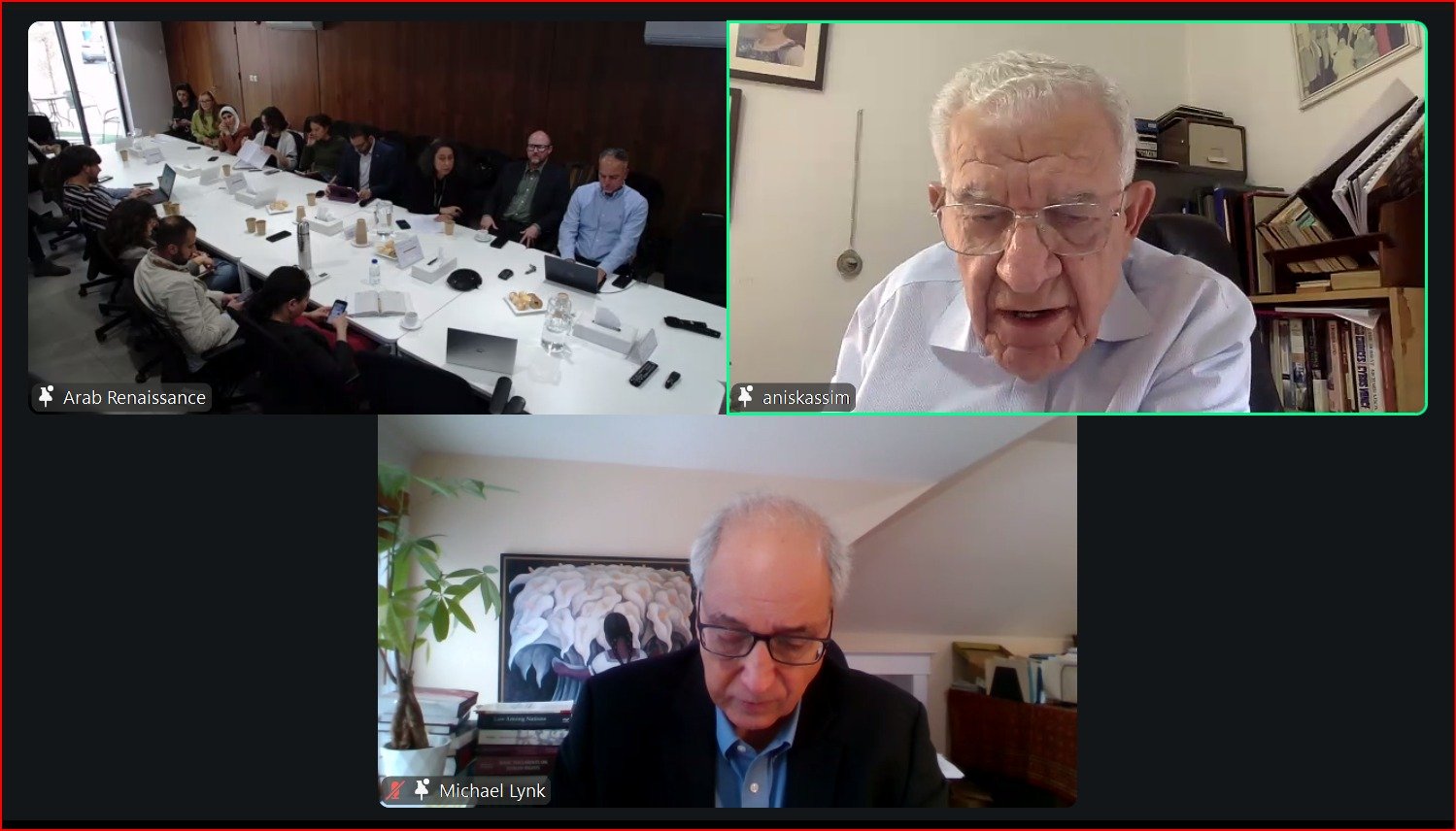
The Question of Palestine Programme at ARDD’s Renaissance Strategic Centre (RSC), in partnership with Law for Palestine (L4P), hosted a high-level hybrid event titled “The International Court of Justice Advisory Opinion on Israel’s Obligations Towards UN Agencies, Other International Organizations and Third States: Initial Reflections.”
Held on 17 November 2025 in Amman and online, the event brought together leading experts and practitioners in international law. Speakers included Ardi Imseis, a member of the legal team that contributed to the proceedings leading to the ICJ Advisory Opinion; Michael Lynk, former UN Special Rapporteur on the situation of human rights in the occupied Palestinian territory; Mona Ali Khalil, whose extensive expertise in UN legal frameworks and the law governing international organisations provided a critical lens through which to interpret the Opinion; Anis F. Kassim, a pioneering figure in legal scholarship on Palestine’s international legal status and the rights of its people; and Matthew Hoisington, Chief of International Law at UNRWA’s Department of Legal Affairs, whose institutional perspective offered unique insights into the Opinion’s implications for UNRWA’s mandate and operational space. The discussion was moderated by Ihsan Adel, Founder and Chair of Law for Palestine.
The event focused on the Advisory Opinion delivered by the International Court of Justice (ICJ) on 22 October 2025, following a request by the UN General Assembly in December 2024. The Opinion addresses the responsibilities of states and international organisations in the context of an ongoing genocide and humanitarian catastrophe, and for the third time examines Israel’s conduct both as an occupying power and as a UN member state. Building on the ICJ’s 2004 and 2024 Advisory Opinions, it forms part of an increasingly coherent legal framework addressing the illegality of Israel’s prolonged occupation and its conduct during ongoing hostilities, challenging impunity and centring Palestinian rights.
Although not explicitly referenced in the question before the Court, panelists noted that the request was prompted by Israel’s ban on UNRWA and its escalating restrictions on humanitarian access, at a time when Gaza is experiencing unprecedented destruction, famine, forced displacement and the collapse of essential systems. Across the discussion, experts emphasised that the Advisory Opinion reaffirms fundamental and binding principles of international humanitarian law and international human rights law.
Beyond restating core legal norms, the Opinion provides significant factual findings, particularly concerning the obstruction of humanitarian assistance and attacks on UNRWA, which are likely to influence current and future international litigation. The panel highlighted that the ICJ firmly rejected allegations questioning UNRWA’s neutrality, finding no substantiated evidence to support Israel’s claims. The Court recognised UNRWA’s decades-long presence and its “unique and sustained connection” with the population of Gaza within the framework of international law, reinforcing the agency’s mandate and underscoring Israel’s obligation to cooperate with it in good faith. Speakers warned that efforts to delegitimise or dismantle UNRWA—through military attacks, legislative bans, the withdrawal of immunities and political pressure—have direct and devastating consequences for Palestinian civilians, while simultaneously increasing Israel’s own legal responsibilities as the occupying power.
As an occupying power, Israel is obligated to ensure the provision of essential supplies to the Palestinian population and to facilitate, rather than obstruct, relief operations by the United Nations, particularly UNRWA. Under Article 59 of the Fourth Geneva Convention, the occupying power must permit and support relief schemes and refrain from any form of forcible transfer or deportation. Panelists observed that Israel’s sustained attacks on UNRWA and its obstruction of humanitarian assistance amount to an implied attempt to withhold relief from the population, creating conditions that could pressure residents to leave the territory. The Court explicitly linked the withdrawal of relief schemes to the prohibition on the forcible transfer of the protected population.
The Court further reaffirmed that Israel has no claim to sovereignty over any part of the Occupied Palestinian Territory and that its occupation is unlawful, noting that the UN General Assembly has already set 18 September 2025 as the deadline for Israel’s complete withdrawal. Panelists reflected that, for many years, international debates focused on managing the occupation within the confines of international law rather than bringing it to an end. The ICJ’s 2024 Advisory Opinion marked a decisive shift by determining that Israel’s continued physical presence in the territory is itself unlawful. Nonetheless, speakers highlighted the persistent gap between the clarity of international law and the absence of meaningful international accountability. While the legal framework governing occupation, humanitarian protection and the right to self-determination is well established, the political will to enforce these norms remains critically lacking.
Several panelists noted that Israel’s disregard for its obligations under the UN Charter, combined with its obstruction of UN agencies and humanitarian actors, raises serious questions about its standing within the United Nations. Should Israel continue to defy binding decisions of the General Assembly, the Security Council and the ICJ, its position within the UN system could be challenged, with some speakers pointing to the measures adopted by the General Assembly in relation to apartheid South Africa in 1974 as a possible precedent.
The Advisory Opinion thus serves as an authoritative legal reference demonstrating Israel’s sustained failure to act in good faith, to cooperate with the United Nations, and to respect the privileges and immunities of the UN and its personnel. Panelists stressed that Israel’s actions aimed at restricting UNRWA’s work are incompatible with its obligations under the UN Charter and the 1946 Convention on the Privileges and Immunities of the United Nations. They further emphasised that the Court’s findings apply equally to Francesca Albanese, the UN Special Rapporteur mandated by the Human Rights Council to monitor and report on the situation in the occupied Palestinian territory, whose functions are similarly protected under international law.
The event concluded with a unified message: the ICJ Advisory Opinion provides a clear and authoritative legal foundation that must now be translated into political action, operational protection and meaningful accountability. The obligations clarified by the Court are neither optional nor aspirational; they are binding requirements of international law. Ensuring their implementation is essential to the protection of the Palestinian people, the integrity of the United Nations system and the preservation of international accountability.