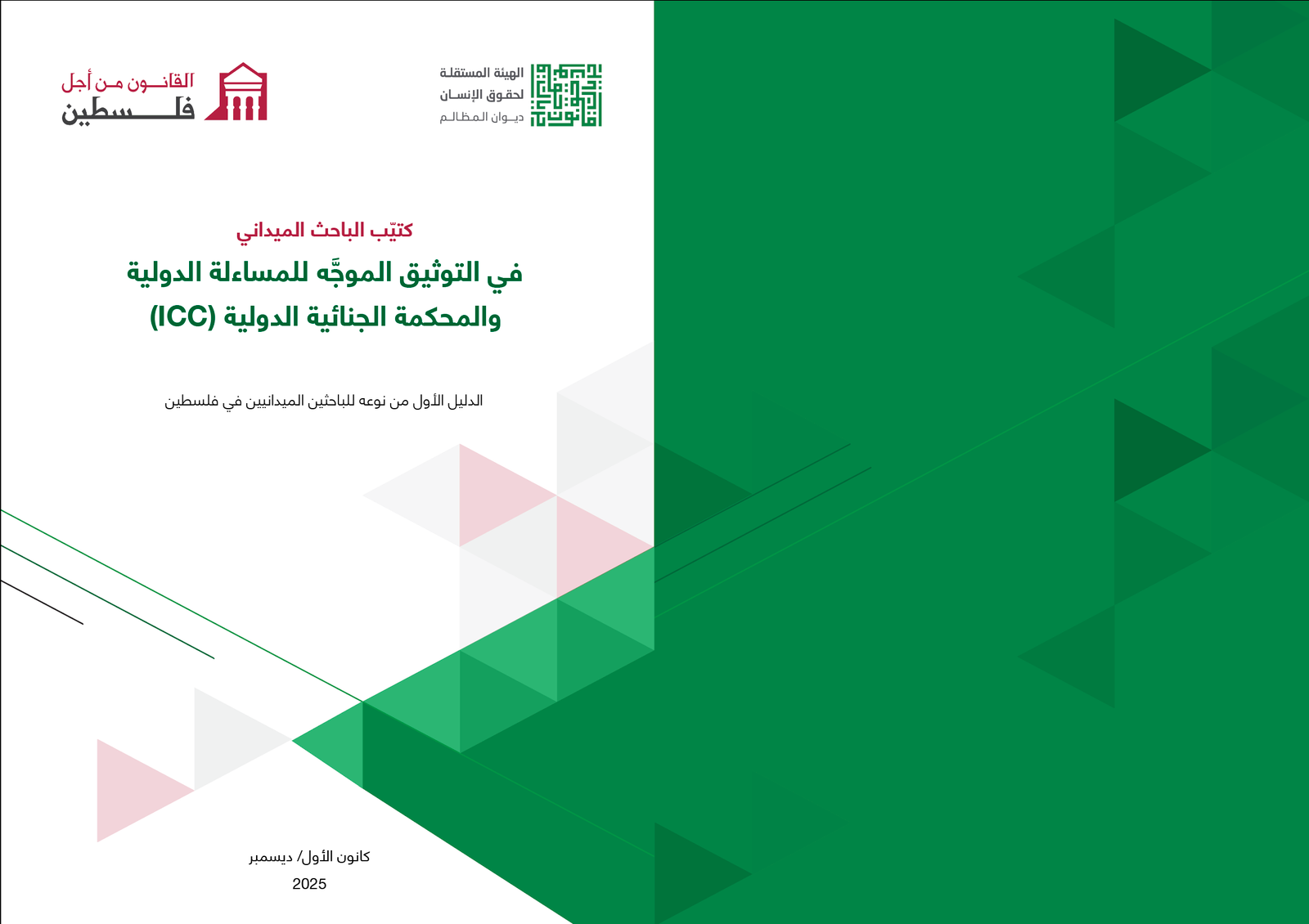
Law for Palestine and the ICHR launch a guide for field researchers on collecting testimonies and documenting international crimes in Palestine
Law for Palestine – United Kingdom, in collaboration with the Independent Commission for Human Rights (Ombudsman Office) in Palestine, has published a new guide for field researchers in Palestine. Titled “Field Researcher’s Handbook on Documenting for the International Criminal Court (ICC) and Other Accountability Mechanisms, Using the CCC Methodology – with a Special Focus on the Palestinian Context,” the guide is available in Arabic.
The guide sets out robust methodologies for documenting testimonies and statements relating to war crimes and crimes against humanity in the occupied Palestinian territory, in line with international standards. It is designed to ensure that such material can be effectively used before criminal courts, particularly the International Criminal Court.
Beyond explaining how to document violations, the guide also addresses why and how such documentation can serve as a powerful tool in the pursuit of justice and in holding perpetrators of international crimes to account, whether before the ICC or other international accountability mechanisms.
Its significance is underscored by the continued commission of grave breaches of international law by the occupying power, alongside the accumulation of acts that amount to war crimes, crimes against humanity, and genocide. This highlights the urgent need for professional, methodical documentation capable of supporting both national and international accountability efforts. The guide also responds directly to the complex challenges faced by field researchers in Palestine.
It aims to support human rights organisations, field researchers, and journalists in transforming the daily realities of suffering and violations into reliable, court-ready material, while safeguarding the dignity of victims and witnesses and minimising risks to all involved. The guide also emphasises the importance of developing coherent legal narratives and navigating the specificities of the Palestinian context -including political divisions, social and familial pressures, and security risks- without compromising professional and legal standards.
In addition, the guide stresses the importance of strict objectivity and professional rigour in gathering testimonies and evidence, alongside a clear commitment to the rights of Palestinian victims to justice and reparations.
It outlines documentation approaches suitable for use before international courts, most notably the Correct, Concrete, Coherent (CCC) methodology, adapted to the realities of the Palestinian context, including ongoing violations and security concerns. It also places particular emphasis on protecting witnesses and researchers from ethical, security, and digital risks, maintaining the integrity of evidence and its chain of custody, and supporting researchers’ mental wellbeing as an essential element of sustainable human rights work.
The issuing bodies emphasise that documenting violations is not merely an administrative or technical exercise, but a legal and ethical act in confronting impunity, and a long-term endeavour in the pursuit of justice. Every carefully documented testimony and properly preserved piece of evidence contributes to building a credible record of truth and accountability, and strengthens the work of Palestinian and international organisations in this field.
The guide is structured into seven main sections:
- The framework of international accountability in the Palestinian context
- The CCC methodology in handling testimonies
- Field interviews in Palestine – from initial concept to written account
- Documenting violations and the elements of international crimes
- Evidence and chain of custody in a context of occupation and blockade
- From Palestinian testimony to a case file before the International Criminal Court
- The wellbeing and protection of the field researchers
It also includes appendices with practical templates for documenting testimonies.