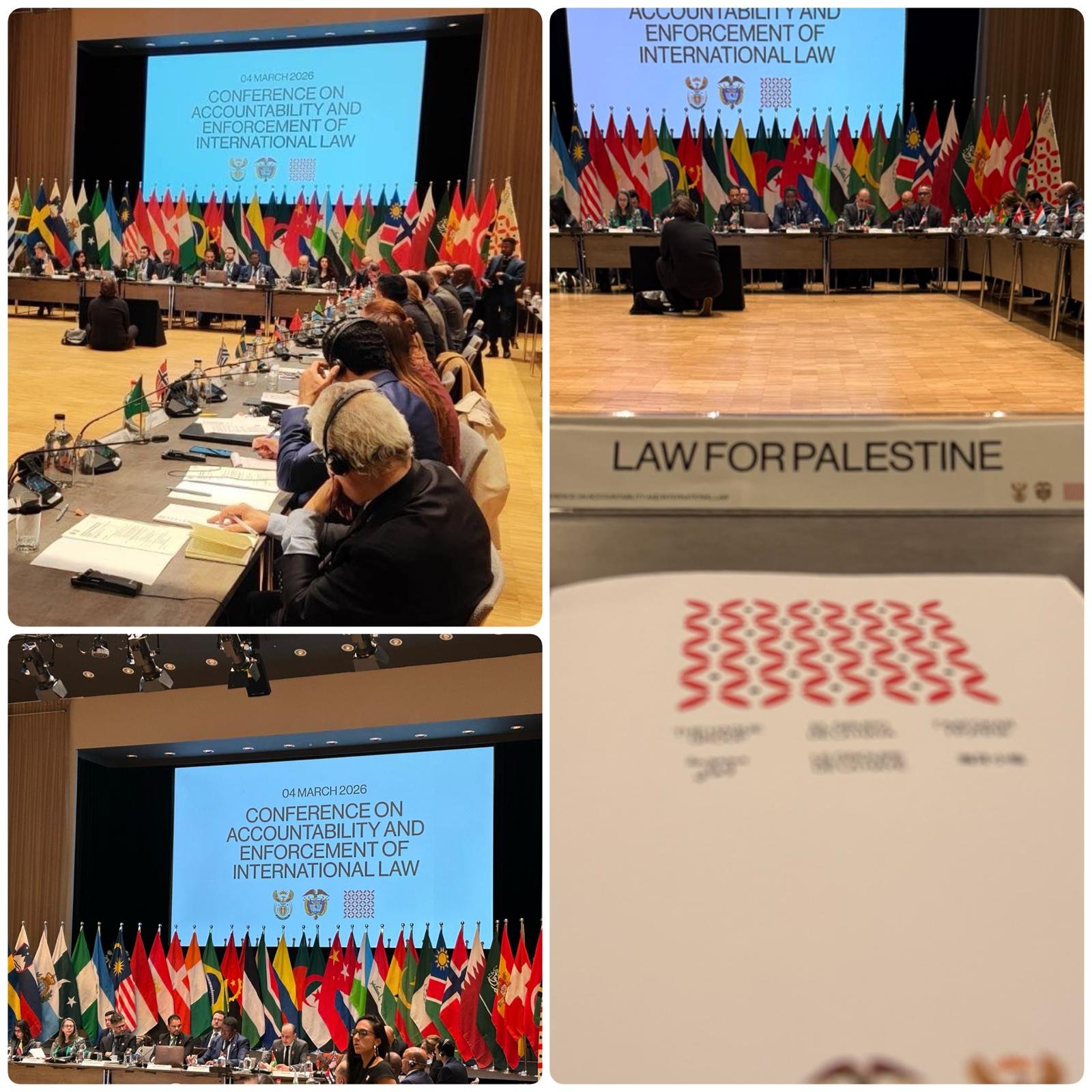
Law for Palestine Calls for Concrete International Action at The Hague Conference
The Hague, 4 March 2026
Law for Palestine (L4P) participated in the Conference on Accountability and the Enforcement of International Law in Palestine, convened in The Hague by the co-chairs of the Hague Group, with almost 40 states in attendance. The conference underscored a shared principle: international law must be universal, not selective.
L4P called on states to move beyond rhetorical condemnation and take concrete legal measures to uphold international law, including under the UN Convention on the Law of the Sea, the Genocide Convention, the Apartheid Convention, and the Geneva Conventions. Emphasising the Palestinian people’s right to self-determination, L4P stressed that state inaction directly contributes to violations of peremptory norms of international law.
During its intervention, L4P, building on the work done with our partners at ASCOMARE, outlined two primary tracks for immediate action:
- Port and Territorial Sea Controls: Under Article 19 of UNCLOS and customary international law, coastal states have a duty to prevent non-innocent passage through their territorial seas, particularly when underlying conduct contributes to serious violations of international law.
- Flag State Responsibility: States must exercise effective jurisdiction and control over vessels flying their flags, as required under Article 94 of UNCLOS, to ensure they do not facilitate genocide, apartheid, or other serious breaches of peremptory norms.
To operationalise these obligations, L4P recommended that states:
- Institutionalise mandatory risk-based due diligence for vessels seeking port entry.
- Ensure mechanisms for immediate notification, precaution, and enforcement action where a risk of non-compliance with international law is identified.
- Establish coordinated regional and international frameworks to enhance port State control and structured information-sharing, including a shared vessel monitoring
- Develop a coordinated dual-use control framework reflecting emerging technologies, evolving conflict dynamics, and the need to prevent indirect facilitation of serious violations of international law.
L4P also acknowledged the principled engagement of South Africa and Nicaragua with the International Court of Justice on issues of genocide and Third State responsibility, noting that these efforts strengthen accountability mechanisms in domestic jurisdictions across the world.
The Hague Group co-chairs, South Africa and Colombia, convened the conference against the backdrop of the continuing genocide in Gaza and the rapidly escalating Israeli settlement expansion and military operations in the West Bank, which constitute de facto annexation and direct violations of international law. Participants affirmed the importance of the UN Charter and international legal order, calling for robust accountability measures, non-recognition of illegal settlements, and an embargo on arms and dual-use materials.
In addition to its participation in this meeting convened by the Hague Group co-chairs, L4P will join the People’s Congress in Amsterdam on 7 March 2026, marking the first anniversary of the Hague Group’s formation. The Congress will bring together unions, popular movements, political parties, and parliamentarians to support Palestinian self-determination. The Congress will be followed by a public event, which is open for registration here.