New Scholarship Reaffirms Enduring Legal Status of Palestinian Refugees Under International Law
A newly published academic chapter by Prof. Dr. Mutaz M. Qafisheh, Head of the Board of Trustees of Law for Palestine, and Dr. Jinan Bastaki, Associate Professor of International Law at New York University Abu Dhabi, argues that the legal status and rights of Palestinian refugees remain intact despite more than a century of displacement and conflict.
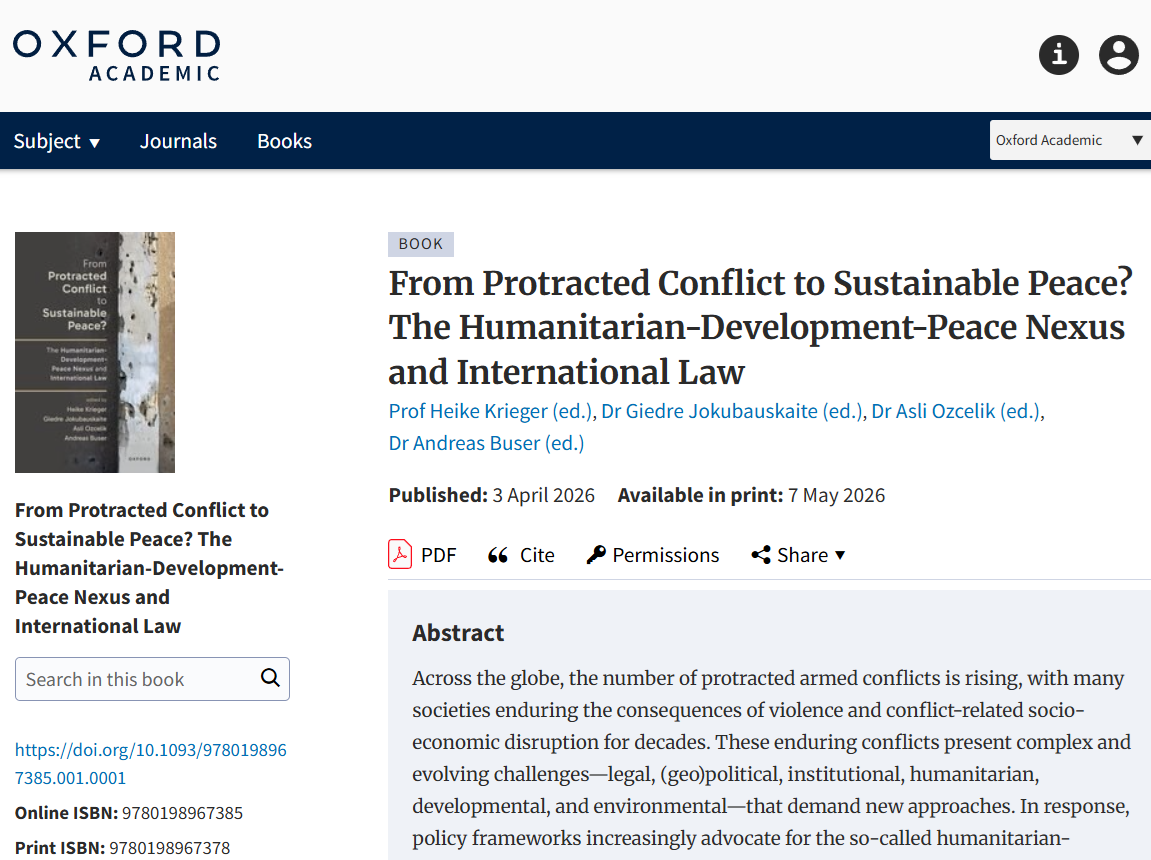
The chapter, titled “Refugees in Protracted Conflicts: The Lasting Legal Status of Multigenerational Palestinian Refugees,” appears in the edited volume From Protracted Conflict to Sustainable Peace? The Humanitarian-Development-Peace Nexus and International Law, edited by Prof Heike Krieger, Dr Giedre Jokubauskaite, Dr Asli Ozcelik, and Dr Andreas Buser, and published by Oxford University Press. The volume brings together contributions from 33 scholars worldwide, examining legal and policy pathways from enduring conflict towards sustainable peace.
The authors situate the Palestinian refugee question within a broader historical trajectory beginning with the British Mandate period, including the 1925 Palestine Citizenship Order, and continuing through successive waves of displacement in 1948, 1967, and more recent hostilities. They argue that, contrary to claims that the passage of time weakens legal entitlements, international law continues to recognise the enduring rights of Palestinian refugees – most notably the rights to repatriation and reparation.
“The protracted conflict that created four generations of dispossessed Palestinians does not preclude the constant relevance of the refugee status of these peoples. Creeping legal evidence, coupled with numerous factual indicators, implies that the passage of time would not affect the ongoing rights of Palestinian refugees as a group and as individuals under international law.”
Central to the chapter’s analysis is the assertion that prolonged conflict has not diluted refugee status but has instead contributed to the emergence of a form of customary international law that sustains these rights across generations. The authors contend that as long as claims remain asserted and unresolved, legal entitlements persist, drawing parallels with principles in civil law concerning property rights, inheritance, and compensation for wrongful acts.
The chapter also highlights the unique institutional framework surrounding Palestinian refugees. Unlike other refugee populations, Palestinians remain under the mandate of a dedicated UN agency, the United Nations Relief and Works Agency for Palestine Refugees in the Near East (UNRWA), alongside the broader protection regime of the United Nations High Commissioner for Refugees (UNHCR). This dual framework is reinforced by Article 1D of the 1951 Refugee Convention, which the authors interpret as providing a continuing basis for protection until a durable solution is reached. This, together with dozens of United Nations General Assembly resolutions on Palestinian refugees, embeds a continuing responsibility on the international community.
Recent political developments are also addressed, including legislative actions by Israel targeting UNRWA, and the subsequent response of the United Nations General Assembly, which reaffirmed the agency’s mandate at a December 2024 emergency session.
The authors further reference the July 2024 advisory opinion of the International Court of Justice, which recognised ongoing rights of displaced Palestinians from territories occupied in 1967. They argue that this reasoning is likely applicable across all generations of Palestinian refugees, given their shared legal status.
The chapter concludes that the protracted nature of the Palestinian situation does not extinguish legal claims. Instead, it reinforces a continuing legal framework in which refugee status -and the rights attached to it- remain active until a just resolution is achieved.
– The full chapter is available here (open access) – click