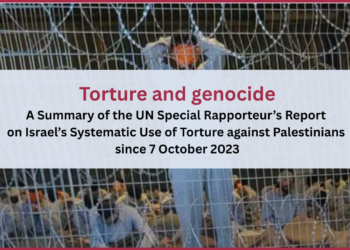
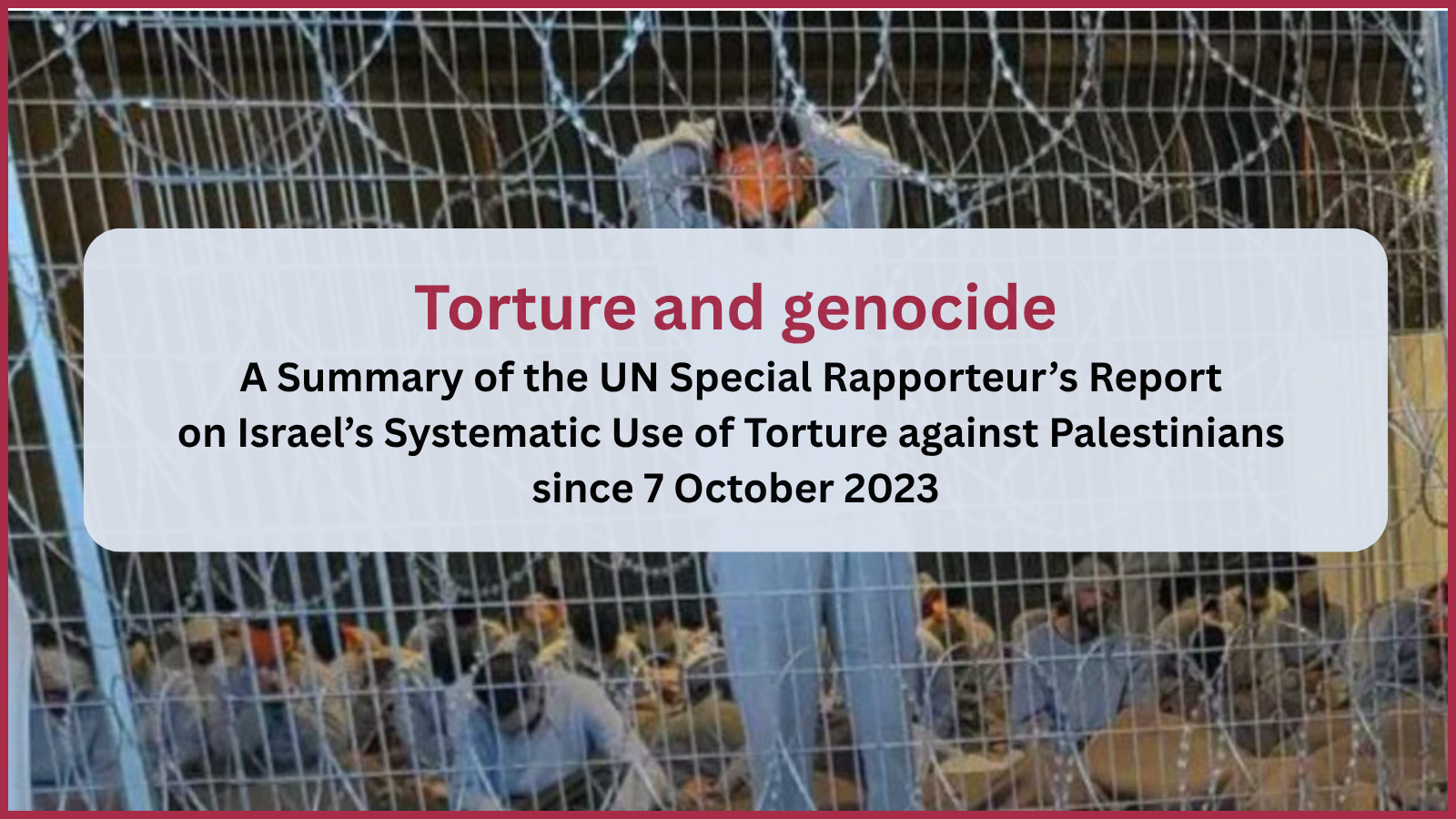
Torture and Genocide: A Summary of the UN Special Rapporteur’s Report on Israel’s Systematic Use of Torture against Palestinians since 7 October 2023
Prepared by Law for Palestine
Overview
On 23 March 2026, the Special Rapporteur on the situation of human rights in the Palestinian territories occupied since 1967, Francesca Albanese, presented her latest report to the UN Human Rights Council during its 61st session. The report examines Israel’s systematic use of torture against Palestinians from the occupied Palestinian territory since 7 October 2023, and illustrates how it functions as a “structural feature of the ongoing Israeli genocide and broader settler-colonial apartheid” (para. 1).
As with previous reports, the Special Rapporteur’s attempts to gather evidence for the report were obstructed by Israel, thus the report relies on remote consultations with legal experts and torture survivors as well as 300 written testimonies, collected by numerous organisations, along with an analysis of primary and public sources, including accounts by Israeli whistle-blowers (para. 2). The Special Rapporteur was also denied entry to Egypt, where she had planned to meet with released Palestinian prisoners and hear their testimonies about conditions inside Israeli prisons.
To showcase the link between torture and genocide, the report analyses the rationale behind the torture, (paras. 19-22) followed by a closer look specifically at torture in detention, its drastic escalation since October 2023 (paras. 23-29) and the main methods of torture systematicaly used against both adult and child detainees (paras. 30-46), revealing how torture functions as a strategy of the genocidal campaign. The report then shifts perspective and addresses genocide as a mode of torture, considering the implications of inflicting severe physical and psychological suffering on the entire group as such. Here, the report breaks down the genocidal process intended to eliminate the capacity of a group to survive, finding that in Gaza, it has turned the entire strip into a torture camp (para. 50-60), while in the West Bank, including East Jerusalem, a torture continuum has evolved whereby techniques of settler colonial expulsion and genocide are wielded to inflict sustained collective suffering and intergenerational trauma (paras. 61-68). The analysis regards torture as the aggregate effect of genocidal violence pursued by Israel, rejecting the fragmented characterisation of torture as discrete conduct that has historically enabled impunity (paras. 69-71). Finally, it addresses the pervasive perception at all levels of Israeli society that there exists a ‘right to torture’ Palestinians, noting that it has turned torture into a collective enterprise (paras. 72-81).
The Special Rapporteur documents how torture has become integral to the domination, collective punishment and annihilatory violence aimed at Palestinians as a people, inflicting long-term pain and suffering and imposing a continuous, territorially pervasive regime of psychological terror designed to break bodies, instil collective fear, deprive a people of their dignity and force them from their land. This reflects the very architecture of settler-colonialism, built on a foundation of dehumanisation through a policy of cruelty and collective torture. Having always been a central component of Israel’s dispossession of Palestinians, torture has become a structural feature of the current genocide.
The report outlines how Palestinian people are being subjected to multiple humiliations and types of violence both through custodial and non-custodial forms of torture. The former manifests in the brutal practices of Israel’s detention system and the broader carceral regime which normalise cruelty and operate as an ideological project of societal destruction and debilitation of the Palestinian nation. On the other hand, the non-custodial collective torture takes the form of mass displacement, siege, denial of aid and food, unrestrained military and settler violence, and pervasive surveillance and terror, cumulating in the destruction of the conditions of life with long-term mental and physical consequences for the occupied population.
The ultimate, and avowed, objective of the ‘torturous environment‘ is the forcible removal of Palestinians to enable annexation and settler conquest, creating an intimate relationship between torture and settler-colonial genocide (para. 6). Its systematic use across an entire territory, against the population “as such” and through policies of destroying conditions of life, breaking bodies, minds, and collective resilience to erode the group’s physical integrity and psychological survival, is evidence of genocidal intent (para. 7).
Applicable legal framework
The report begins by setting out the legal framework for the prohibition of torture under international law (paras. 9-18). Under international law, the prohibition of torture and other inhuman or degrading treatment or punishment is absolute and non-derogable (jus cogens). In addition, all states must investigate, criminalise, punish and provide redress for acts of torture that take place in territory under their jurisdiction or effective control (para. 9).
Torture is a war crime on its own but can also amount to a crime against humanity (CAH) or form part of the CAH of apartheid (para 11). Individual acts of torture can constitute distinct CAH, such as persecution, rape, or starvation; however they often function as interdependent components of a single regime of domination and destruction (para 11).
The Special Rapporteur observes that “any genocide involve[s] some forms of torture” (para. 12). Torture that causes “serious bodily or mental harm” also constitutes an act of genocide as per Art. II(b) of the Genocide Convention when carried out with the requisite intent to destroy a group in whole or in part. The systematic use of torture against a population may also constitute evidence for the specific intent to destroy as it demonstrates “deliberate harm foreseeability and the instrumentalisation of suffering” (para. 13).
The “serious bodily harm” threshold involves significant health impairment or disfigurement, while “serious mental harm” may constitute, inter alia, terror, fear or coercive measures that fundamentally impair the victim’s ability to lead a normal life (para. 14). Severe suffering often results from prolonged mistreatment not single acts. Prolonged deprivation, threats and enforced insecurity may together inflict psychological torture at scale as part of a “torturous environment”(para. 15).Legal scrutiny therefore considers the cumulative effects of the carceral environment and policies as well as the intention, severity and purpose behind them. Where they involve “the deliberate and purposeful infliction of fear” and aim at “intimidating or coercing”, the resulting harm reflects torture’s core purpose: the intended suffering to establish “complete dominance” (para. 17). The Special Rapporteur further demonstrates how the genocidal process itself constitutes a “structurally torturous regime,” operating through methods of destruction intended to eliminate the capacity of a group to survive (para. 17).
III. Torture as an act of genocid
A. Rationale
In this section, the Special Rapporteur examines the factual evidence of systematic torture as a genocidal act in the occupied Palestinian territory, looking at the use of torture in detention as well as the methods of torture employed (paras. 19-46). She begins by situating these practices within a broader colonial legacy, highlighting how dehumanisation has underpinned colonial and racially ordered regimes by legitimising torture, humiliation and erasure as “regular” administrative procedures (para. 19). Under the British Mandate in Palestine, torture tactics that had been refined in Irelandwere transferred to Zionist militias and later integrated into Israel’s security apparatus. From early state-building through prolonged occupation, these practices have metastasised into an “ecosystem of discriminatory legal frameworks and abusive operational practices” (para. 22). In 1987, Israel’s own Landau Commission endorsed the doctrine of “necessity,” allowing both psychological and “moderate physical pressure” on persons suspected of terrorism (para. 21). The doctrine was upheld in 1999 by Israel’s High Court and further expanded in 2018, resulting in near-blanket impunity: of more than 1,300 torture complaints filed between 2001 and 2020, only two investigations were conducted and no indictments were issued (para. 21).
B. Escalation of torture in detention
Since October 2023, torture in detention has been used on an unprecedented scale as “punitive collective vengeance” whereby all Palestinians have been treated collectively as “terrorists” and “security threats” (para. 23). The report records that Israeli authorities have arrested over 18,500 Palestinians, including at least 1,500 children (para. 24). As of February 2026, 9,245 Palestinians remain in detention, including 1,330 sentenced prisoners, 3,308 remand detainees, 3,358 administrative detainees held without trial, and 1,249 classified as “unlawful combatants.” More than 4,000 have been subjected to enforced disappearance, with many likely dead. Authorities initially concealed detentions and locations, and a detainee tracing mechanism introduced in May 2024 has failed to provide families, lawyers, or the ICRC with access to information or facilities (para. 24).
Israeli soldiers have detained entire communities along with their disabled, pregnant, elderly and children (para. 25). Activists, doctors, health workers, scholars, scientists, political figures, journalists and UNRWA staff have been specifically targeted for detention and heightened abuse, at times resulting in violent death (para. 28). Since October 2023, in addition to Israel Prison Service (IPS) facilities, Israeli authorities have detained Palestinians in ad hoc military camps such as Sde Teiman, Anatot, and Ofer, where treatment is especially inhumane (para. 26). The regime of torture and cruelty across the detention network is operationalised and tightly coordinated through the IDF, the Israeli Security Agency (Shin Bet), the Israeli Police and the IPS (para 29).
C. Methods of torture
In this section, the Special Rapporteur examines the forms of torture carried out by Israeli authorities against Palestinians in the occupied territory (paras. 30-40), drawing on reports and submissions from Palestinian and international civil society organisations alongside UN bodies such as the UN Committee against Torture and the Office of the High Commissioner of Human Rights.
Palestinian prisoners have been held in degrading conditions and subjected to severe food restrictions, a policy Itamar Ben-Gvir, Israel’s National Security Minister, described as one of his “highest goals” (para. 30). Abuse starts from the moment of arrest where detainees are blindfolded, violently restrained, stripped naked, and paraded by Israeli soldiers (para. 31). Transfers, averaging 4.5 times per detainee, are designed to induce stress, disorientation and fear: detainees are painfully handcuffed, urinated on, subjected to insults targeting their identity and faith, as well as death threats (para. 32). In custody, Palestinians are held outdoors in so-called “monkey cages,” or in cramped cells, sometimes underground (para. 33). Detention conditions are severe, including prolonged blindfolding and shackling, deliberate exposure to cold temperatures, prolonged isolation, starvation, dehydration, sleep deprivation, restrictions on the use of showers or toilets, being forced to use diapers, and being blindfolded for days, even during medical proceedings (para. 33). Images of the destruction of Gaza are displayed in prisons holding Palestinians from Gaza, constituting a form of psychological torment (para. 35).
Severe physical violence is pervasive, including waterboarding, suspension by cuffed hands, severe beatings with batons and other weapons, pepper spraying, tear gassing, electrocution, skin burning with cigarettes, assault dogs, hallucinogenic drugs, being forced to kneel on gravel, stay in stress positions or bend over while being slapped, beaten and systematically humiliated (para 34). In addition, the report documents the use of torture during interrogations where individuals are continuously subjected to deafening music in so-called “disco rooms” for sensory overload, sleep deprivation and psychological collapse. Threats of rape and murder of detainees and loved ones are routine and detainees are made to perform acts of extreme submission and “act like animals” (para 36). Detainees are further subjected to severe sexual violence, often while blindfolded, including gang rape, involving objects such as iron bars, batons and metal detectors, as well as beatings and electrocution of genitals and anus (para. 37). Detainees are photographed naked and women and girls are forced to remove veils in front of men (para. 37). The denial of medical care necessary to treat the effects of torture and starvation is systematic (para. 38).
Special Rapporteur notes that this systematic torture is enabled by the obstruction of legal assistance in the form of intimidation of detainees and and violent “disuasion” tactics to stop them from speaking freely with their lawers, as well as access bans, security interrogations and cancellations of visits (para. 40).
The Special Rapporteur zooms in on three additional aspects of torture by Israeli authorities: extreme “unchilding”, deaths in custody, ill-treatment upon release and the use of torture as a strategy (paras. 41-46). She records how Palestinian children are increasingly detained without charge or trial without contact to their families or access to lawyers (para. 41). Children are subjected to the same torture and ill-treatment as adults in what the Special Rapporteur characterises as extreme “unchilding” (para. 42).
The report documents a particularly high number of deaths in custody since October 2023, estimated between 84 and 94 (para. 43). It notes that Israeli authorities often withhold the bodies of deceased or return them only when decomposition compromises autopsies and prevents identification. These practices amount to ill-treatment of families denied the basic dignity of mourning the loss of their loved ones (para. 44). In addition, the report highlights the practice of releasing detainees without notice in random locations, often injured, without clothes and in the middle of night, which is presented as part of a “broader pattern of denial of dignity” (para. 45).
Finally, the report examines how, since October 2023, the above described torture has been “integrated” into the genocidal campaign, openly declared and publicly performed (para 46). The systematic targeting of specific professional categories, such as doctors, further demonstrates an intent “to dismantle the technical capacities needed for a group’s survival”.
According to the Special Rapporteur, this is not torture merely as punishment, but torture as a strategy: it operates to “degrade Palestinian bodies, fracture psychological integrity, and erode collective resilience” (para. 46). The physical and psychological harm of even short-term detention often affects entire families and communities in an enduring and irreparable way.
IV. Genocide as torture
After setting out the ways in which torture has been used as a tool of genocide, the Special Rapporteur explores how genocide itself has become a mode of torture inflicting severe physical and psychological suffering on the entire group as such (paras. 47-71). The Special Rapporteur underlines the way in which torture dehumanises the victim and thus serves as what she describes as “an archetype of exclusion from the human comunity” (para. 48). The manifestations of genocide as a mode of torture are examined in Gaza and the West Bank respectively (paras. 50-68).
A. Gaza
The report documents how, in Gaza, acts of genocide have engendered permanent mental and physical suffering for Palestinians as a group, turning the strip into a vast torture camp where nowhere is safe and fear is perpetual (para. 50). By depicting the entire population as “human animals” and “terrorists,” or invoking the notion of “human shields” and terrorists in the making when referring to children, Israel has turned the entire civilian population into a target (para. 51).
Mass displacement has been used to create pervasive mental and physical pain under the threat of extermination, forcing nearly two million people to flee, abandoning everything and navigating through chaos to reach “humanitarian areas” unsafe and unfit for human life (para. 52).
The population has been forced to watch helplessly as homes, belongings, hairlooms as well as places of education and collective memory such as schools, mosques, libraries, museums and cultural sites have been obliterated. This systematic dismantling of the material foundations of a culture targets the social fabric itself, attacking a people’s sense of identity, continuity and belonging (paras. 53-55). The systematic destruction of rescue equipment has left more than 10,000 trapped under rubble and survivors searching for them with their bare hands while collecting scattered body parts of the deceased (para. 55).
The healthcare system has itself become a target with nearly all hospitals damaged or destroyed, doctors, nurses and ambulances targeted, surgeries performed without anaesthetic and patients dying from lack of life-saving care and preventable infections. The pain and death resulting from the dismantling of medical care as a policy has been a calculated tool of terror (para 56). Permanent disablement has been inflicted on a mass scale with 40,000 people sustaining life-altering injuries – at least 4,000 have lost limbs – including 10,000 children. Such pervasive maiming causes long-lasting trauma, debilitation, fear and vulnerability (para.57).
An intentional state of siege and starvation has further caused severe bodily and mental suffering. At least 461 people, including 157 children, have died from malnutrition, while hunger has strained social bonds, “mutual support yielding to the individual instinct to survive” (para. 59). Desperate civilians were lured into food distribution sites which functioned as traps. The Special Rapporteur notes how “starvation used as societal torture is a revived colonial technique that causes mass misery and cumulative and irreversible harm, devastating a people’s present and future” (para. 59).
The Special Rapporteur describes how, in a system of continuous coercion and punishment, advanced weaponry serves not only to kill but to generate fear, helplessness and psychological collapse. Incessant drone surveillance, swarms of quadcopters, dumb bombs, massive impact weaponry, thermobaric weapons, white phosphorous and AI targeting systems – are deployed to cause superfluous injury or unnecessary suffering in violation of the Additional Protocol I of the Geneva Conventions, integrating cutting-edge technologies of genocide into practices of collective torture (para. 60).
B. West Bank including east Jerusalem
The report documents how the Israeli occupation has established an omnipresent, high-tech system of inescapable surveillance across the entire Occupied Palestinian Territory, which functions as a torture mechanism by instilling a climate of fear in communities, eroding social bonds and supressing individual freedoms (para. 61). Large-scale military operations drive collective destruction and forcible displacement (para. 62).
Since October 2023 this carceral continuum has evolved into a torture continuum sustaining collective suffering and intergenerational trauma (para. 63). The IDF and settler militias function as a system of terror which constitutes torture. Attacks by military and/or settlers have risen drastically, leading to 1,054 killings of Palestinians between 2023 and 2025 with legal impunity and widespread praise (para. 64).
Critical infrastructure, houses, livelihoods and agricultural resources have been destroyed and more than 40,000 people have been displaced. Every dimension of daily life has been disrupted, escalating prolonged physical, mental and social torment (para. 66).
Settler groups celebrate the destruction of Gaza and threaten the Palestinians of West Bank with the same fate reflecting the settler-colonial mindset of using genocidal destruction as a form of inflicting collective torture and suffering threatening indigenous presence on the land (para 68).
C. Torture as aggregate effect of genocidal violence
The Special Rapporteur points to a statement by Smotrich which exposes the relationship between the infliction of collective torment and settler colonial genocide: “They will be totally despairing, understanding that there is no hope and nothing to look for in Gaza, and will be looking for relocation to begin a new life in other places” (para. 69).
The resulting “collective torture against Palestinians as a group” is experienced as a continuum of chronic insecurity, fear and suffering (para. 62).
Assessing genocide as a torturous environment evaluated cumulatively across the totality of the conduct against the totality of the population in the totality of the land, these practices reveal a coherent architecture (para. 71).
V. The ‘right to torture’ Palestinians
The report notes how torture and the genocidal intent driving it are articulated by Israel’s executive and enabled, justified and normalised by the legislature, which enacts and amends laws to allow torture, while the judiciary consistently privileges security claims over fundamental rights and thus ensures impunity (paras. 73-74). Beyond the State apparatus, medical professionals, religious authorities, media, academia, public figures and other segments of the public have contributed to the rhetoric, consent and operational conditions that sustain torture, making it a collective enterprise: “a society-wide system in which dehumanization is intentional, violence is authorized and accountability deflected” (paras. 77-81).
Senior ministers have described torture as a “holy job”, investigations into abuses within prisons as national betrayal, and abusers as “heroic warriors” (paras. 76-77). Medical professionals have been complicit in torture, with prison doctors performing amputations without anaesthetic, failing to document and report abuse, falsifying records and even participating in beatings and forced feedings of detainees. (para. 78) Religious leaders have been reframing abuse as a duty and have publicly encouraged collective punishment (para. 79). Media, academia, popular and digital culture echo the same (para. 80).
Conclusions
The Special Rapporteur concludes that:
“Since October 2023, the systematic torture of Palestinians has become an integral component of the genocide, functioning as an instrument of annihilatory violence directed at the Palestinians as a people with apparent genocidal intent.” Both through custodial and non custodial policies and practices, the infliction of collective long-term harm reflects a concerted effort to control and erase a people (para 82).
Palestinian captives have been subjected to ruthless physical and psychological abuse inflicting profound and lasting scars on their bodies and minds and those of their loved ones (para 84). The system has descended into a regime of systemic and widespread humiliation, coercion, and terror, aiming at stripping Palestinians not only of their liberty but of their dignity, identity, and even the most basic sense of humanity (para 84). Such conduct has been institutionalized within detention structures, politically endorsed by Israeli authorities, and publicly justified, or even celebrated, by segments of society (para 84).
Palestinians are subjected to conditions that cumulatively inflict severe collective physical and psychological suffering. In this torturous environment, the intentional destruction of the conditions necessary for life makes daily existence an ordeal of exhaustion, trauma and precarity (para 85).
Genocide has become “the ultimate form of torture: continuous, generational and collective” (para. 86). The comprehensive system of destruction is calculated to inflict permanent suffering, annihilate everyday life, and create an environment of sustained anguish with the aim of eroding the possibility of political, cultural and territorial continuity and obliterating once and for all the Palestinian right to self-determination (para. 86). This constitutes both the infliction of serious bodily and mental harm under Article II(b) of the Genocide Convention, and intentional, collective torture. (para 86).
Ben-Gvir, Smotrich and Katz are the politicians which preside over these policies. Any credible pursuit of justice must confront torture not as an isolated crime, but as a foundational pillar of a genocidal project aimed at the complete erasure of the Palestinian people (para. 87).
VII. Recommendations
The Special Rapporteur urges Israel to (para. 89).:
(a) Immediately cease all acts of torture and ill-treatment, dismantle apartheid, end the occupation and ensure accountability, full reparation, guarantees of non-repetition and measures to preserve memory through institutional and educational reform
(b) Give access to the ICRC, UN Commission of Inquiry, OHCHR, UN experts and lawyers needed to monitor violations and investigate all crimes committed
The Special Rapporteur urges Member States to (para. 92):
(a) Comply with their obligation not to participate in or be complicit in Israeli crimes, and to instead prevent and address serious breaches of international law
(b) Enhance the mechanisms and resources to collect evidence for prosecutions, clarify the fate of all missing Palestinians and ensure Israel provides adequate
(c) Activate universal jurisdiction mechanisms to try individuals and corporate entities suspected of involvement in grave breaches and other international crimes
(d) Support programmes for psychosocial support for survivors and facilitate transfer of survivors to third States.
(e) Ensure corporate entities and their executives cease all engagements with Israel
The Special Rapporteur urges the Office of the Prosecutor of the International Criminal Court (para. 93):
To investigate and prosecute acts of genocide, torture and ill-treatment and request arrest warrants for Ben-Gvir, Katz and Smotrich as well as the Chief of the General Staff of the Israeli military and high-ranking officials within the IPS in charge of detention centres.
The Special Rapporteur furthermore urges States and international institutions to do everything in their power to stop the destruction of what remains of Palestine (para. 93).
* Presentation of Francesca Albanese’s report at the UN Human Rights Council: Click
** The full report is available here – Click