
ASCOMARE and Law for Palestine Launch the Toolkit for Port State Control and Military Transfers (2026)
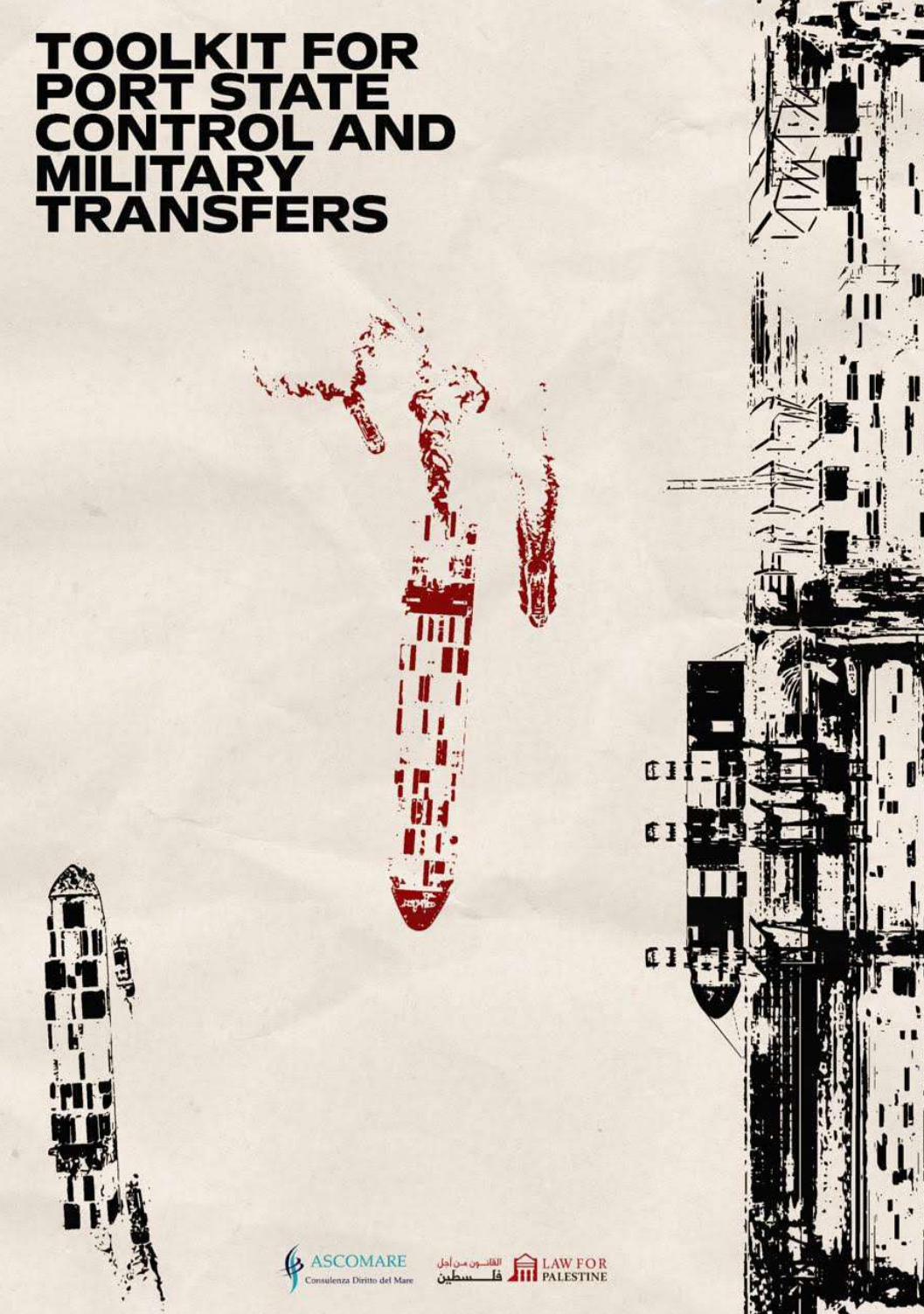
Addressing the responsibilities of States and maritime actors in preventing the illicit transfer of arms, military equipment and other prohibited items to high-risk destinations, the Associazione di Consulenza in Diritto del Mare (ASCOMARE) and Law for Palestine have just launched the “Toolkit for Port State Control and Military Transfers”.
The Toolkit brings together the law of the sea, international arms-transfer obligations and general international law to provide a practical framework for strengthening due diligence and preventive action by States and maritime actors.
The Toolkit builds on two earlier publications developed as part of this work:
– Legal Opinion on the Maritime Transport of Arms and Dual-Use Materials: Prepared by eight experts in the law of the sea, coordinated by ASCOMARE and published by the Boycott, Divestment, and Sanctions (BDS) National Committee. The opinion examines the legal framework governing the passage through the territorial sea of vessels transporting arms and dual-use materials where such transfers are inconsistent with international law. It also addresses the international responsibility of flag States where they fail to exercise effective jurisdiction and control over such vessels.
– Implementing Guidelines: Commissioned by the BDS National Committee and developed by ASCOMARE and Law for Palestine, the document is entitled “Maritime Transport of Military Materiel and Dual-Use Components Used for Genocide, Apartheid and Other Atrocity Crimes (Guidelines for Operationalising States’ Obligations Under the Law of the Sea)”. It translates the conclusions of the legal opinion into operational checklists designed to assist States, whether acting as port, coastal or flag States, in effectively discharging their obligations under international law.
This newly published Toolkit builds on this work by providing a structured due diligence framework for Port State Control (PSC), including a practical, ready-to-use model for port authorities. It is designed to operationalise States’ obligations under international law to prevent military transfers where there are credible grounds to believe that they may facilitate serious violations of international law. These include breaches of peremptory norms prohibiting genocide, aggression, crimes against humanity, apartheid, slavery and torture, as well as violations of fundamental rules of international humanitarian law and the right to self-determination.
Drawing on recommendations from the Stockholm International Peace Research Institute (SIPRI) and the United Nations Office of the High Commissioner for Human Rights (OHCHR), the framework seeks to strengthen the implementation of applicable transfer rules and procedures and promote harmonised risk assessments to prevent transfers prohibited under international law. The proposed PSC framework enables authorities to pre-identify vessels according to four risk categories (Risk 1, Risk 2, Risk 3 and Risk 4) before they enter port. This allows the relevant authorities to take appropriate measures to ensure compliance with international law, including denying port entry, conducting inspections or seizing cargo, where legally warranted.
The Toolkit sets out recommended rules, templates and procedures relating to:
– harmonized criteria for determining a vessel’s risk profile to inform the actions of port authorities (Annex I);
– a prior notification template for advance port entry (Annex II);
– harmonized inspection and enforcement schemes and procedures (Annex III);
– a list of relevant sources for the collection of risk-assessment data (Annex IV);
– the establishment of a list of vessels presumed to have engaged in the illegal transport of arms and other prohibited materials (Annex V);
– a reference list of dual-use items (Annex VI);
– operational implementation protocol including pilot evaluation (Annex VII).
Ports must not become blind spots in the implementation of international law. Commercial imperatives cannot eclipse legal obligations, and due diligence must not end where accountability begins. We reaffirm the vital role of dockworkers and port workers, alongside port authorities, regulators, shipping companies and other maritime stakeholders, in ensuring that maritime trade operates within the boundaries of international law.