Balfour, British Imperialism and Palestine: Study Examines the University of Edinburgh’s Colonial Legacy
An academic study by Nicola Perugini and Shaira Vadasaria examines the historical connections between the University of Edinburgh, British imperialism, and the dispossession of Palestinians through the legacy of Arthur James Balfour, the former British Prime Minister and Chancellor of the university.
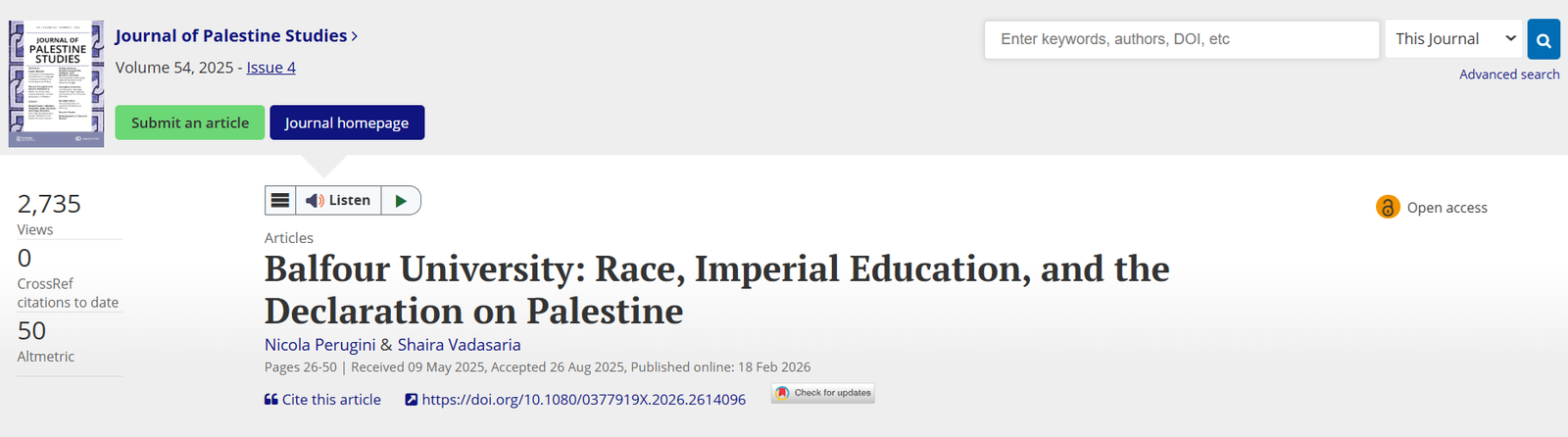
Titled “Balfour University: Race, Imperial Education, and the Declaration on Palestine,” the article was published in the Journal of Palestine Studies, Volume 54, Issue 4, pages 26-50.
The authors explore two interconnected aspects of Balfour’s legacy: his political role in advancing racial policies and settler-colonial dispossession in Palestine, and his academic leadership in promoting imperial education and racial thinking. They argue that the 1917 Balfour Declaration cannot be understood as an isolated diplomatic decision, but must be situated within the broader racial and imperial ideologies that shaped British colonial policy.
The study particularly examines the University of Edinburgh’s historical entanglement with these ideologies, challenging the separation between Balfour’s political activities and his influence within academia. It argues that universities were not simply observers of imperial expansion but also contributed to producing and legitimizing the knowledge and ideas that sustained colonial systems.
The article also connects this historical legacy to contemporary developments at the University of Edinburgh, particularly student and staff mobilization in response to Israel’s military campaign and its genocide in Gaza. The authors discuss the student hunger strike and the campaign demanding university divestment from companies connected to Israel’s military operations. They report that more than 600 university staff members signed a letter supporting divestment and the student mobilization.
Perugini and Vadasaria criticize the university’s reluctance to implement divestment measures, arguing that acknowledging historical responsibility for Palestinian dispossession must be accompanied by concrete institutional action. They emphasize that colonialism and imperialism should not be treated merely as historical legacies, but as structures whose consequences continue into the present.
The study concludes by calling on universities across Western countries to investigate their historical and contemporary connections to Palestinian dispossession, including through institutional archives, collections, buildings, scholarships, and financial investments.
Its concluding call, “Balfour Must Fall Everywhere,” urges academic institutions to move beyond symbolic recognition of colonial history towards meaningful institutional accountability and reparative justice.
* Read the full article here – click