Nicaragua v. Germany before the ICJ: Key Questions and Answers on the Case Concerning Germany’s Support for Israel
Q and A
Public hearings from 7 to 10 September 2026 at the International Court of Justice on the preliminary objections raised by Germany in Alleged Breaches of Certain International Obligations in respect of the Occupied Palestinian Territory
* This blog provides background information on the case and is not intended to constitute a legal analysis. It will be updated regularly with relevant developments in the proceedings, as well as new analysis and other relevant material. Law for Palestine will publish a separate analytical paper examining the arguments presented by both parties during the hearings.
* * *
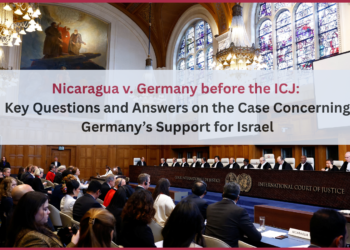
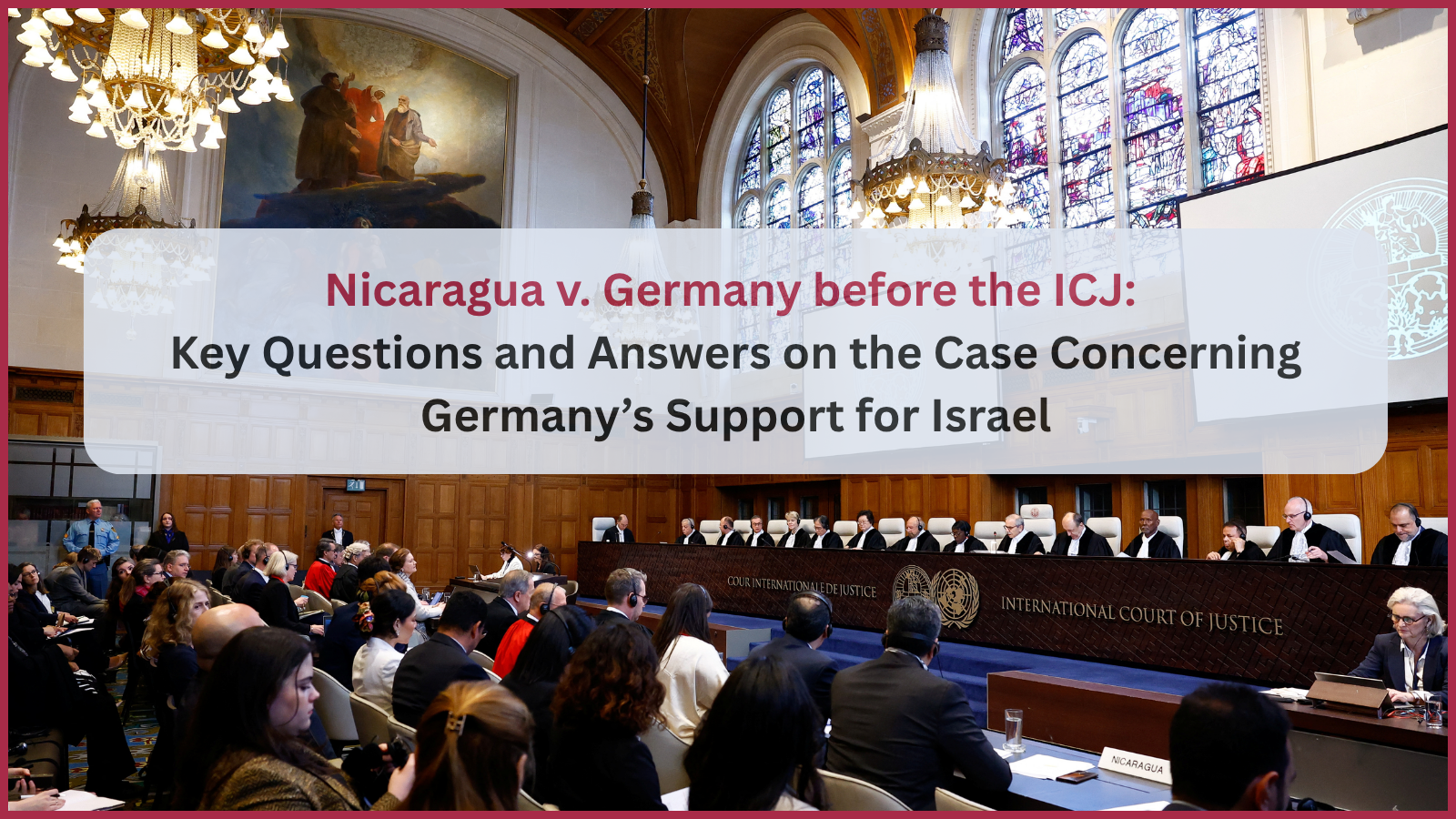
The International Court of Justice (ICJ) is holding public hearings from 7 to 10 September 2026 on the preliminary objections raised by Germany in the case brought by Nicaragua concerning Germany’s conduct in relation to the Occupied Palestinian Territory, particularly the Gaza Strip. The first hearing was held yesterday, 7 September.
The hearings are addressing questions of jurisdiction and admissibility, rather than the substantive merits of Nicaragua’s claims. The proceedings are being held in public and can be watched on the UN Web TV here.
- What is this case about?
Nicaragua brought this case in March 2024, against the backdrop of Israel’s military attack on the Gaza Strip and the grave humanitarian situation there. Nicaragua argues that, while there was an internationally recognised and increasingly serious risk of genocide and widespread violations of international humanitarian law against Palestinians in the Occupied Palestinian territory, especially the Gaza Strip, Germany continued to provide political, financial, and military support to Israel, including military equipment.
Nicaragua argues that Germany had its own obligations under international law to take measures to prevent genocide, not be complicit in genocide, to ensure respect for international humanitarian law, not to aid or assist internationally wrongful conduct, not to violate Palestinian self-determination, and to condemn Israel’s racial discrimination, segregation and apartheid against the Palestinian people.
Nicaragua is asking the ICJ to examine Germany’s actions with respect to the Occupied Palestinian Territory and determine whether Germany itself has violated its international obligations (see question 2 below), including through the supply of arms, academic support, its obligations concerning corporations under German jurisdiction, and other forms of material support to Israel.
The case is therefore not a case against Israel. Nicaragua is asking the Court to examine Germany’s own conduct and its own international obligations as a third State in relation to the situation in the Occupied Palestinian Territory.
- What are the legal claims Nicaragua is making in this case?
Nicaragua argues that, in light of Germany’s conduct, including its provision of military and other support to Israel, Germany has failed to comply with a number of obligations under international law. In particular, Nicaragua alleges breaches relating to:
- International humanitarian law, including Germany’s obligation to respect and ensure respect for the Geneva Conventions and to take appropriate measures to prevent serious violations of international humanitarian law;
- the right of the Palestinian people to self-determination;
- the prohibition of racial discrimination, segregation and apartheid; and
- the 1948 Genocide Convention, including the obligation to prevent genocide, failure to prosecute, and allegations concerning Germany’s assistance to Israel in circumstances where Nicaragua argues that there was a serious and recognised risk of genocide.
Nicaragua’s position is that Germany has independent obligations as a third State and cannot avoid responsibility for its own conduct simply because the alleged underlying violations are being committed by another State. The question before the Court is therefore whether Germany, through its own actions and omissions, has breached obligations that apply to Germany itself.
- At what stage is the case?
Nicaragua brought proceedings against Germany in March 2024 and, at the same time, asked the ICJ to indicate provisional measures – urgent measures intended to protect the rights at issue while the case was pending. The ICJ had oral hearings for provisional measures in April 2024. The Court decided that the circumstances at that stage did not require it to indicate the provisional measures requested by Nicaragua. Importantly, this was not a judgment on the merits of Nicaragua’s case. The Court did not find that Germany had complied with international law, nor did it decide that Nicaragua’s substantive claims were unfounded. The Court also declined to remove the case from its General List, allowing the proceedings to continue.
The Court’s decision not to indicate provisional measures was based on information provided by Germany concerning its domestic system for reviewing and licensing arms exports, as well as Germany’s submission that there had been a significant decrease, since November 2023, in the value of military equipment for which export licences to Israel had been granted.
At the same time, the Court emphasised that all States have international obligations concerning the transfer of arms to parties to an armed conflict, and that those obligations apply to Germany in relation to its supply of arms to Israel.
Following the 2024 proceedings, Nicaragua submitted its Memorial on the Merits in July 2025, setting out the evidence and legal arguments on which it relies. In October 2025, Germany responded by raising preliminary objections to the admissibility of certain of Nicaragua’s claims and challenging the jurisdiction of the Court. Under the Court’s Rules, the filing of preliminary objections suspended the proceedings on the merits. Nicaragua responded to Germany’s objections in February 2026.
The ICJ will now hear oral arguments on those preliminary objections from 7 to 10 September 2026. The Court will then take its time to reflect on the proceedings and issue an order in the coming months. If the Court finds that some or all of Nicaragua’s claims are admissible, the case will proceed to the merits stage.
- What are the key legal issues the Court will address at this stage?
The hearings concern procedural questions of jurisdiction and admissibility. The Court will not decide at these hearings whether Germany ultimately violated international law. The key issues include the following:
- Whether Nicaragua followed the proper procedure in bringing this case before the Court: This matters because the ICJ generally requires a genuine dispute between the parties concerning a question of international law before it can exercise jurisdiction. Germany challenges whether, at the time Nicaragua instituted proceedings, there was a sufficiently established legal dispute between Nicaragua and Germany falling within the Court’s jurisdiction. Nicaragua argues that it has fulfilled all the requirements to establish a dispute between the parties.
- Whether the Court has jurisdiction over Nicaragua’s allegations concerning Germany’s failure to prevent and condemn racial discrimination, segregation, and apartheid in the Occupied Palestinian Territory.
- Whether Nicaragua’s allegations fall within the temporal limits of Germany’s acceptance of the Court’s jurisdiction: Germany has only accepted the Court’s jurisdiction over issues arising from “situations or facts” after 2008. Germany argues that this temporal limitation matters to Nicaragua’s claims, while Nicaragua rejects this claim and asserts that Germany conflates the background of the case with the claims brought forward by Nicaragua.
- Whether the Court can decide the merits of the case without Israel being a party to the proceedings (the Monetary Gold issue): Germany argues that Nicaragua’s claims depend on findings concerning Israel’s conduct, including whether Israel has committed violations of the Genocide Convention or international humanitarian law. Israel, however, is not a party to the case. Germany therefore invokes Monetary Gold, under which, in certain circumstances, the Court cannot decide a dispute where doing so would necessarily require it to determine the legal responsibility of an absent third State. Nicaragua rejects this characterisation, arguing that the case concerns Germany’s own international obligations and its own conduct.
- Why is this case significant?
Third States play a critical role in maintaining Israel’s settler-colonial regime and unlawful occupation of the Occupied Palestinian Territory, the denial of the Palestinian people’s right to self-determination, its system of apartheid, and serious violations against the Palestinian people, including genocide. Nicaragua’s case against Germany is therefore significant beyond Germany itself, as it could establish an important precedent for ensuring accountability for States that participate in, facilitate or contribute to the maintenance of unlawful situations and serious violations of international law in Palestine.
Germany has justified its political and military support for Israel through its policy of Staatsräson (a fundamental principle of German state policy, particularly its commitment to Israel’s security). Nicaragua argues that Germany’s provision of weapons and other military support, political and financial support, academic cooperation and technical expertise to Israel breaches Germany’s own international obligations. A State’s foreign-policy commitments cannot displace its independent obligations under international law. The case also highlights Germany’s broader conduct, including restrictions on and repression of pro-Palestinian protests and advocacy for accountability for Israel’s conduct in Palestine.
Germany, like all States, has obligations under the Geneva Conventions, the Genocide Convention and customary international law not to aid or assist serious violations of international law and, where applicable, to take measures to prevent them. The case raises important questions concerning genocide, including what may constitute complicity or assistance in genocide, when the duty to prevent genocide is triggered, and what States must do to discharge that duty.
The consequences of continued arms transfers are particularly important. The case could clarify when supplying weapons or military assistance, in circumstances where there is a known or foreseeable risk of their use in genocide or serious violations of international humanitarian law, may engage the responsibility of the supplying State. This could provide guidance to other States supplying arms or military assistance to Israel.
The significance of the arms issue is illustrated by the scale of Germany’s military relationship with Israel. According to the Stockholm International Peace Research Institute (SIPRI), Germany accounted for 31% of Israel’s imports of major arms in 2021-25, making it Israel’s second-largest supplier after the United States.
The case also raises the obligations of third States towards the Palestinian people’s right to self-determination. States have obligations not only to refrain from supporting the denial of that right, but also to cooperate in bringing unlawful situations to an end. Nicaragua’s case therefore concerns the responsibilities of States towards the Palestinian people and the unlawful situation in the Occupied Palestinian Territory, and could further clarify the obligations of third States in relation to apartheid and other serious violations of peremptory norms.
The proceedings also raise questions about other forms of cooperation with the unlawful Israeli occupation. Continued academic, scientific and technological cooperation with Israeli institutions may require scrutiny where such cooperation contributes to or facilitates unlawful activities or the maintenance of an unlawful situation. Similarly, the case may help clarify the obligations of States in relation to economic activities involving the exploitation or pillage of Palestinian resources and property, including where State conduct enables, supports or facilitates such activities by corporations.
The case is therefore important for accountability, cessation, reparations and deterrence. If the Court reaches the merits, its findings could provide guidance to States on the limits of permissible military, political, economic, academic and other forms of cooperation with a State alleged to be committing serious violations of international law. Its implications could extend well beyond Germany and Palestine to other States whose conduct may contribute to the continuation of unlawful situations or grave violations of international law.
- What are the key legal issues the Court could address, if the case proceeds to the merits stage?
If the case proceeds to the merits stage, it can push the Court to reflect on fundamental issues beyond Germany, such as:
- Third States legal obligations with regards to Palestinian self-determination
- What constitutes complicity in genocide and the temporality of the duty to prevent
- Legal consequences for Third States continuing to supply arms to Israel
- Legal responsibility for States and State institutions continuing to cooperate with Israeli institutions, including academic institutions
- Legal responsibility for States failing to prevent corporations domiciled within their jurisdictions from engaging in the exploitation and pillage of the Occupied Palestinian Territory.
- Legal responsibility for States failing to adequately contribute to the suppression, prevention, and condemnation of genocide, violations of international humanitarian law, and racial discrimination, segregation, and apartheid.
- Case Timeline
1 March 2024
Nicaragua filed an Application instituting proceedings against Germany for alleged violations by Germany of its obligations under the Convention on the Prevention and Punishment of the Crime of Genocide of 9 December 1948 (the “Genocide Convention”) and the Geneva Conventions of 1949 and their Additional Protocols, as well as “intransgressible principles of international humanitarian law and other peremptory norms of general international law” in relation to the Occupied Palestinian Territory, in particular the Gaza Strip.
8 and 9 April 2024
Oral proceedings took place at the ICJ for the provisional measures requested by Nicaragua.
30 April 2024
The Court found that the circumstances, as they then presented themselves to the Court, were not such as to indicate provisional measures. But the case continues.
21 July 2025
Nicaragua filed its Memorial, a detailed dossier with factual data and legal arguments for the all the violations by Germany of its international legal obligations.
21 October 2025
Germany filed preliminary objections to the jurisdiction of the Court and to the admissibility of certain claims contained in Nicaragua’s Memorial. This was not a response to the substantive claims made by Nicaragua but only the procedural aspects of the case at this stage.
23 February 2026
Nicaragua presented a written statement of its observations and submissions on the preliminary objections raised by Germany.
7 to 10 September 2026
Public hearings will take place at the International Court of Justice on the preliminary objections raised by Germany. Both sides will get to present their views to the Court.
Next steps
Following the oral hearings, the Court will rule if has the jurisdiction on the violations identified by Nicaragua and if these violations are admissible. The Court will, presumably rule on this before February 2027. If the Court decides that some/all of Nicaragua’s claims are admissible the case will then proceed to discussing the substance of the violations.
- Reference material
Case documents
- International Court of Justice: https://www.icj-cij.org/case/193
- Written proceedings, including Nicaragua’s Memorial of 21 July 2025, Germany’s Preliminary Objections of 21 October 2025, and Nicaragua’s Written Statement on the Preliminary Objections raised by Germany of 23 February 2026, are all available here: https://www.icj-cij.org/case/193/written-proceedings
Factual background
- Forensis: https://content.forensic-architecture.org/wp-content/uploads/2026/09/Forensis-Report-Addendum-German-Arms-Exports-to-Israel-2023-2026-1.pdf
- Al Jazeera: https://www.aljazeera.com/news/2026/7/27/german-arms-export-licences-for-israel-surge-with-focus-on-sub-project
- Not in Our Name Coalition: https://www.notinourname-tu.org/water-apartheid
- Don’t Buy into Occupation: https://dontbuyintooccupation.org/wp-content/uploads/2025/11/2025-DBIO-V-report-1.pdf
- ECCHR: Arming International Crimes – Germany’s Continuing Arms Exports to Israel 2023–2026 https://www.ecchr.eu/fileadmin/Publikationen/ECCHR_Report_Arming_International_Crimes_EN.pdf
Legal background
- William Schabas: https://www.deutsche-juristinnen-voelkerrecht.org/blog/interview-professor-william-schabas-djfdv/
- Jinan Bastaki: https://brill.com/view/journals/pyio/25/1/article-p87_4.xml?srsltid=AfmBOor1-Qhsj177796ZuVMZgIl8TovbhEdx5lBTDuqgJEqf2baiUhS6
- Adil Haque: https://www.justsecurity.org/124907/nicaragua-germany-israel-indispensable/
- Parisa Zangeneh: https://opiniojuris.org/2024/09/25/the-icjs-insufficient-engagement-with-germanys-interpretation-of-the-external-dimension-of-common-article-1-in-the-nicaragua-v-germany-proceedings/