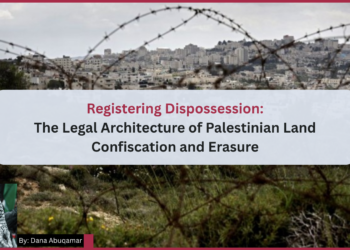

Registering Dispossession: The Legal Architecture of Palestinian Land Confiscation and Erasure
By: Dana Abuqamar *
“A land without a people, for a people without a land.” Zionist texts are often littered with such slogans,[1] deployed in furtherance of Israel’s propagandist mission of attaching legitimacy to its ethnocratic and inhumane project. This piece situates the particular phrase in the context of modern developments with respect to the “Zionist project’s continued presence in the Holy Land”. While its literal interpretation has been long debunked, the slogan’s colonialist underpinnings remain unscathed, repeatedly driving Israel’s policies of Palestinian dispossession and echoing the logic of the civilising mission captured in Winston Churchill’s infamous description of Palestinians’ roots in the land: “I do not admit that the dog in the manger has the final right to the manger, even though he may have lain there for a very long time.” [2]
This blog post examines recent legislative developments in Israel concerning Palestinian land and situates them within the broader framework of Israel’s policies towards Palestinian territory and its annexation practices since the Nakba of 1948. This includes developments in Area C of the West Bank, East Jerusalem, and policies affecting the Indigenous Palestinian population within Israel itself.
Against this backdrop, the blog argues that Israel’s legal construction of Palestinian private lands as state land functions as a colonial spatial mechanism designed to sustain and legitimise ongoing domination over Palestinian lands across historic Palestine. As such, the article concludes that law, within this settler-colonial context, law does not function as a neutral mechanism merely regulating space; rather, it actively produces it, serving as a tool for reshaping the demographic composition in ways that consolidate territorial control, facilitate settlement expansion, and enable the gradual but systematic confiscation of Palestinian land and the forced displacement of its people.
West Bank Land Registration: Infrastructure of Annexation
A key expression of this legal architecture emerged on 15 February 2026, when the Israeli government approved a mechanism of land registration in Area C of the illegally occupied West Bank. This area, home to 180,000-300,000 Palestinians and constituting almost 60% of the West Bank, remains subject to full Israeli control, both administrative and military. Presented as an administrative reform designed to systematise property rights, the registration mechanism carries significant implications for Palestinian private land ownership. It is designed to consolidate Israeli control over Palestinian land and facilitate de facto annexation, as stated by Israeli Finance Minister Bezalel Smotrich, who introduced the proposal underpinning this land registration mechanism and described it as part of a continuation of “the settlement revolution to control all our lands”.
The contemporary mechanism of land registration as a mechanism for annexation represents just one element of the Israeli legal framework aimed at dispossessing Palestinians of their property. It cannot be understood in isolation from the broader historical and legal architecture governing Palestinian property rights.
Historically, Palestinian land registration was codified in the Nüfus (Ottoman population registry) during the Ottoman rule, and thereafter in the British Mandate census data, followed by registration initiatives undertaken by the Jordanian government after the Nakba in 1948. After the Naksa, the 1967 war, and Israel’s occupation of the West Bank, Israel halted the Jordanian land registration process, thereby preventing Palestinians from formally recording ownership of their property. This has resulted in only around one-third of the territory being officially registered. Over time, many of the remaining records or registration documents were lost, damaged, or destroyed, particularly in areas subjected to Israeli military operations during and after the 1967 war, creating structural gaps that now underpin the contemporary registration mechanism.
The 1967 war also marked the displacement of approximately 300,000 Palestinians from the West Bank, in addition to those displaced during the 1948 Nakba. Palestinian refugees, systematically expelled from their lands upon the establishment of the Zionist project and subsequently prevented from returning in violation of international law, became part of a broader process in which forced displacement was transformed into a durable mechanism for the permanent transfer of land ownership and control to the Israeli state.
This trajectory is further entrenched by Israel’s Absentees’ Property Law of 1950, a key legal mechanism that perpetuates the events and consequences of the Nakba. The law grants Israeli occupation authorities the power to seize property belonging to Palestinians classified as ‘absentees’ – a category that includes individuals who were expelled or fled during the Nakba to neighbouring states or other parts of historic Palestine.
It is within this layered legal history that the February 2026 land registration mechanism must be situated. Theoretically, it allows Palestinians to file land registration claims. In practice, however, their ability to realise these ownership rights is severely limited, if not -for many- entirely non-existent.
In effect, the February 2026 policy creates a legal presumption of Israeli state ownership while placing the burden of proof entirely on Palestinian individuals to disprove such presumption
The process imposes a stringent burden of production on Palestinians, requiring documentation that may date back decades. The passage of time since the end of Jordanian administration in Jerusalem (nearly six decades ago), and since the collapse of the Ottoman Empire (more than a century ago), renders the retrieval of such documents exceptionally difficult. In many cases, it necessitates travel, cooperation with other authorities, and access to archival records that are often not readily available. These difficulties -frequently insurmountable in practice- are compounded by the deliberately costly and lengthy procedures that make participation in the process prohibitively difficult, thereby conferring a significant and decisive advantage on Israel in relation to the production and assessment of evidence and, ultimately, the vindication of property rights.
Even where the evidentiary burdens are met, the decision-making process produces outcomes that are at best arbitrary and at worst outrightly discriminatory and targeted against Palestinian claimants. For instance, claimants may be required to demonstrate continuous cultivation of land for periods of up to ten years, a requirement that is difficult to satisfy given restrictions on access and recurring settler violence that limits Palestinians’ ability to use their land.
In effect, the February 2026 policy creates a legal presumption of Israeli state ownership while placing the burden of proof entirely on Palestinian individuals to disprove such presumption. As a result, land under Israel’s illegal occupation may be leased, allocated, or developed by the Israeli authorities unless and until Palestinian claimants can satisfy exceptionally high -and often prohibitive- evidentiary thresholds. This reflects a broader pattern within Israeli law in which Palestinian claims to private life and property are treated not as rights to be protected, but as obstacles to the expansion of the Israeli colonial project and the pursuit of its imperial ambitions.
This logic becomes even more apparent when read alongside the Israeli government’s decision of 8 February 2026, adopted just days before the introduction of the new land registration mechanism. That decision removed longstanding restrictions on land transactions involving Israelis in the West Bank and enabled land to be registered in their names with significantly fewer constraints. The Israeli Defence Minister described the measure as a step towards strengthening Israeli control over the West Bank and advancing settlement expansion.
Parallel developments further underscore this trajectory. The Israeli government transferred certain planning and building powers in Areas A and B of Hebron from the Palestinian Authority to Israeli bodies. It also authorised Israeli enforcement agencies to operate in Areas A and B of the West Bank on matters relating to heritage protection and environmental regulation, thereby empowering them to demolish Palestinian infrastructure deemed harmful to heritage sites, environmental standards, or water resources. In addition, an Israeli governmental committee responsible for land acquisition through the “Custodian of Government Property” in the West Bank was reactivated, serving as a mechanism for securing land for settlement expansion. These measures must be understood within the broader political context of the Israeli Knesset’s vote of 23 July 2025, which declared the West Bank to be “‘inseparable part of the Land of Israel”.
Taken together, these developments -alongside the suspension of Jordanian land registration initiatives after 1967, the 1950 law, settlement expansion, and longstanding confiscatory policies, have interrupted Palestinian ownership claims and created the foundations for this new mechanism, thereby facilitating state acquisition of Palestinian land. The Israeli organisation Peace Now has warned that the policy could allow Israel to assert control over land in Area C whose registration was never completed under Jordanian administration, estimated at approximately 58% of the area.
When combined with increasing settler violence -widely documented as contributing to the creation of a coercive environment that restricts Palestinian presence and land use, often with the protection or acquiescence of the Israeli state- these legal and administrative measures operate in tandem. This ethnic cleansing policy effectively enables the mass transfer of land ownership to Israel, paving the way for expanded settlement construction in the OPTs and the consolidation of territorial control over the occupied territory.[3]
East Jerusalem: Lessons (not) Learned
The land registration measures that Israel is now implementing in the West Bank closely mirror those implemented in East Jerusalem in recent years. Those measures facilitated the gradual transfer of Palestinian property into Israeli state control, thereby reinforcing the area’s de facto annexation. Israel is now pursuing the same strategy in the West Bank.
Having suspended the land registration process initiated under the Jordanian administration of East Jerusalem prior to Israel’s occupation of the area in 1967, Israel resumed the process in recent years – much as it is now doing in the West Bank. As a result, Palestinians who own land in East Jerusalem but became refugees following the 1967 war, or who left the area for other reasons -including those now residing in the West Bank or the Gaza Strip- have effectively been prevented from registering their property. This has occurred through a range of mechanisms, including the application of the Absentees’ Property Law. Notably, Israel has not applied this law to Israeli settlers residing in the West Bank, notwithstanding the fact that, on a strictly formal reading, they too fall within the statutory definition of “absentees”.
Unsurprisingly, less than 1% of Palestinian land in East Jerusalem has been successfully registered under Israeli procedures, and settlements have been built on the newly acquired state land
Unsurprisingly, less than 1% of Palestinian land in East Jerusalem has been successfully registered under Israeli procedures,[4] and settlements have been built on the newly acquired state land. At the same time, many Palestinian title deed holders have unexpectedly found themselves defendants in eviction proceedings brought by Israeli settlers, as seen in the neighbourhoods of Sheikh Jarrah and Silwan. These developments reflect the true colonial ambitions of such policies.
Unlawful Land Registration Measures
Apart from their colonial objectives, these measures -whether in the West Bank or East Jerusalem- constitute a breach of the rules of international law governing occupation.
Under international law, the determination of land ownership is an act that can only be exercised by the sovereign state over its own territory, which Israel cannot do as an occupying power. The law of occupation imposes strict limitations on the authority of an occupying power to alter the legal and demographic character of occupied territory, particularly where such measures facilitate annexation or permanent territorial acquisition. According to the Geneva Conventions, an occupier must administer the territory for the benefit of the protected population, which Israel has consistently failed to do.
Moreover, these measures violate Article 46 of the Hague Regulations, which requires an occupying power to respect private property and expressly prohibits its confiscation, as well as Article 147 of the Fourth Geneva Convention of 1949, which classifies the extensive appropriation of property of protected persons as a grave breach. Moreover, appropriation of property not justified by military necessity constitutes a war crime under Article 8(2)(a)(iv) of the Rome Statute of the International Criminal Court.
In July 2024, the International Court of Justice (ICJ) issued an Advisory Opinion declaring the continued presence of Israel as an occupying power in the OPT unlawful and calling for its termination as rapidly as possible. The Court also expressed explicit condemnation of Israel’s practices and policies of de facto annexation of the OPT aimed at altering the demographic composition of the territory.[5] Accordingly, administrative measures such as the recent land registration mechanism in the West Bank -and those previously implemented in East Jerusalem- operate in direct violation of international law, entrenching practices that the Court has identified as unlawful.
The ICJ has further found that settlement of land title proceedings in East Jerusalem violate the law of occupation and amount to a flagrant breach of the international legal prohibition of the acquisition of territory by force, affirming the United Nations Security Council Resolutions that declare that “all legislative and administrative measures and actions taken by Israel, including expropriation of land and properties thereon, which tend to change the legal status of Jerusalem are invalid and cannot change that status”. [6]
Through mass confiscation of private Palestinian land and reclassification as Israeli state land, these land registration measures operate as key mechanisms within the broader architecture of Palestinian dispossession. Beyond enabling the confiscation of vast Palestinian land reserves across the OPT, these measures also erase native space and facilitate policies of forced displacement. In this sense, legal and administrative mechanisms do not merely regulate territory; they actively shape geography, functioning as spatial mechanisms through which land is reorganised and control consolidated.
The Naqab: Colonial Erasure of Bedouin Territoriality
The dynamics of legal dispossession visible in the West Bank and East Jerusalem are not isolated phenomena; they form part of a broader pattern of land governance that extends across historic Palestine, including in the Naqab (Negev) Desert. Despite the Naqab operating under a different legal status than the OPT -as it falls within the internationally recognised boundaries of Israel and not within the OPT-, the same colonial logic operates to ensure territorial consolidation and demographic engineering across the Zionist project. In the Naqab, similar legal doctrines have been deployed to deny Indigenous Bedouin land claims and legitimise state control over private Palestinian lands.
Historically, Bedouin communities in the Naqab enjoyed territorial governance under both Ottoman and British rule. Ottoman authorities formally acknowledged Bedouin tribal territorial practices following the establishment of the modern city of Be’er Sheba in 1901 as the regional center of the Naqab. During the British Mandate period (1917–1948), British officials similarly recognised Bedouin land customs and made assurances to Bedouin sheikhs that “the special rights and customs of the Bedouin Tribes of Be’er Sheba will not be interfered with”.[7] As a result, the British Mandatory Government excluded Be’er Sheba from the new land law, hence absolving them from the duty of registering land title with the British. Instead, a tribal court was established, which remained active throughout the mandate period and settled land dispute cases following Bedouin tribal law.[8] During this period, more than 160,000 dunums of land in the Naqab were conveyed through a functioning tribal system governing land tenure and property transfers .[9]
Naqab Bedouins are a group indigenous to the Naqab desert pursuant to the international legal framework governing Indigenous Peoples by virtue of their historical continuous presence on the land, tribal social organisation, and self-identification.[10] Land ownership in the Naqab has been vested with the Bedouins by virtue of possession from time immemorial and pervasive cultivation of farmland. Bedouin communities maintained an organised and functioning system of land governance based on tribal territorial practices. Although many Bedouin communities practiced semi-nomadic pastoralism, this mobility followed seasonal patterns and involved returning to the same territories and semi-permanent villages within recognised tribal lands. In this sense, Bedouin territoriality reflected a consistent, elaborate, and well-functioning system of land tenure. Aiming to depict indigenous land relations as primitive and uncivilised, early Zionist writers such as Israel Zangwill implemented the racialised logic of the civilising mission by characterising Palestine as inhabited by “a small population of Arabs and fellahin and wandering, lawless, blackmailing Bedouin tribes”.[11] This portrayal sought to delegitimise Bedouin land claims and undermine existing systems of territorial governance in order to justify settler acquisition of land.
Following the establishment of Israel, Bedouin land tenure systems were displaced by Israeli settlement-of-title legislation that deployed the Dead Negev Doctrine, echoing the colonial Terra Nullius Doctrine. Latin for “land belonging to no one”, it is a spatio-legal justificatory doctrine that facilitates settlements and land nationalisation, though now widely discredited and withdrawn from circulation due to its colonial underpinnings.[12] Under this doctrine, land registration mechanisms classify the entire Negev region as “dead” or “mewat” land, i.e., lands of desolate barren wilderness void of an owner, due to the absence of a title deed or registration of land ownership in the Israeli Land Department. [13]
Despite generations of continuous possession and cultivation of these lands, all land claims brought before Israeli tribunals by Bedouins from the 1970s until today have been lost
As of 2025, more than 86,000 Bedouins live in 35 ‘unrecognized villages’ in the Naqab,[14] whom Israel classifies as trespassers on state land. The very existence of these villages has been outlawed via legislative policies of expropriation, administrative measures, and judicial rubber-stamping: the state’s classification of the whole desert as mewat, hence state land, coupled with the courts’ formalistic approach of land ownership, requiring documentary title and registration with the Israeli land department which does not recognise the Bedouin customary system of land tenure.
The Prawer Plan, approved by the Israeli Knesset in 2013, was devised to resolve the perceived issue of Bedouin land claims in the Naqab through regulatory and spatial planning measures designed to expand and consolidate state control over the region. The plan proposed the demolition of Bedouin villages and the concentration of the Bedouin population in urban centers, or “townships” as part of the larger colonial Judaisation project directed at Palestinian land and space. By rendering continued residence in ancestral villages increasingly untenable, the policy functions as a mechanism of coercion aimed at facilitating Bedouin displacement and dispossession while advancing state territorial control.
Despite generations of continuous possession and cultivation of these lands, all land claims brought before Israeli tribunals by Bedouins from the 1970s until today have been lost.[15] In a recent ruling concerning the Al-Hawashleh tribe, who have resided in the Ras Jbara village of Be’er Sheba for generations preceding the existence of Israel, the Israeli court denied them legal title and upheld their eviction. The Israeli Land Authority has been pursuing eviction and demolition lawsuits against over 500 residents of the village in order to expand the Jewish settlements of Dimona.[16] In defiance of this systemised land expropriation, the village of Al-Araqib in Be’er Sheba, though repeatedly demolished by the state, has been rebuilt by its residents over 200 times.
Accordingly, indigenous territorial systems which historically governed land relations were transformed into legally unrecognisable forms of possession as they did not conform to newly imposed state registration models. As Ahmad Amara observes, “In using a strictly formalistic legal framework to the Negev question, the Israeli government has transformed the Bedouins into criminals and lawbreakers.”[17] In this sense, the law did not merely regulate pre-existing territorial possession; it reconstituted territorial legitimacy itself, redistributing power through ostensibly neutral legal categories of ownership, registration, and legality. By rendering indigenous forms of land tenure legally unintelligible, the state converted the native population into trespassers on their own ancestral lands while simultaneously legitimising its own claims to territorial control. As a result of this categorisation, these communities are deliberately denied access to basic services such as roads, water, electricity, sewage infrastructure, education, and healthcare, in an attempt to coerce them into abandoning their lands and livelihoods. Such measures form part of a broader strategy of demographic and territorial engineering through which Palestinian presence is fragmented, displaced, and subordinated to state spatial objectives, while autonomous Palestinian claims to land are systematically erased.
The Bedouins of the Naqab have long experienced systemic dispossession and the denial of land title recognition by the Israeli government. Israel’s colonial legal system reshapes land claims and imposes a spatial order that reinforces inequality and exclusion, profoundly affecting questions of indigeneity and belonging. By denying land titles that historically operated through tribal territorial practices, the Israeli legal regime constructs a colonial spatial order that erases Bedouin indigeneity and justifies dispossession under the guise of legality.
Conclusion
The land registration mechanisms across the West Bank, East Jerusalem and the Naqab examined in this piece are not mere dry or neutral administrative measures, but rather iterations of Israel’s colonial and imperial ambitions, forming part of a broader architecture of Palestinian dispossession. In this way, law is instrumentalised to reshape demographic compositions, consolidate territorial control, and facilitate the gradual expansion of Israeli settlements.
By rendering longstanding Palestinian land tenure systems legally illegible, the Israeli legal regime reframes dispossession as administrative governance. These policies function as spatial technologies through which geography is reorganised, indigenous presence is erased, and control over land is consolidated.
By contrasting the Israeli state’s legal geography with Palestinian conceptions of land as a living social and historical relation, the Israeli legal system frames Palestinian territoriality as a deviation from legality, while Palestinian communities articulate a counter-legal geography grounded in continuity, belonging, and relationality. This tension reveals how law operates not only to enforce colonial rule but also as a site of contestation over indigeneity.
Colonial legal orders thus produce spatial hierarchies, even as indigenous communities resist these structures through alternative spatial and juridical imaginaries rooted in their lived geographies. Addressing the ongoing dispossession of Palestinians therefore requires confronting not only individual policies, but the broader legal architecture through which colonial control over land is institutionalised and maintained.
* Dana Abuqamar: Published legal researcher with a focus on international law and the Question of Palestine. Holds an LLB from the University of Manchester.
[1] See Israel Zangwill, The Return to Palestine (1901) New Liberal Review p. 615; Diana Muir, “A Land Without a People for a People Without a Land,” (2008) Middle East Quarterly 55-62
[2] Winston Churchill, Peel Commission inquiry into the Arab Revolt in Palestine (1937)
[3] OHCHR, ‘State-backed terror squads at the forefront of Israel’s ethnic cleansing and annexation policy in the West Bank, warn UN experts’ (19 March 2026) https://www.ohchr.org/en/press-releases/2026/03/state-backed-terror-squads-forefront-israels-ethnic-cleansing-and-annexation
[4] Priyanka Shankar, ‘Israel to restart land registration in West Bank. What that means’ Al Jazeera (16 Feb 2026) https://www.aljazeera.com/news/2026/2/16/israel-to-restart-land-registration-in-west-bank-what-that-means
[5] International Court of Justice, Legal Consequences Arising from the Policies and Practices of Israel in the Occupied Palestinian Territory, including East Jerusalem (Advisory Opinion) [2024] paras 278-279
[6] ICJ 2024, para 175
[7] Salman Abu Sitta, ‘Al-Araqib: All of Palestine’ (2011) 85 Majallat ad Dirasat al Filistiniya https://www.plands.org/en/articles-speeches/articles/2011/al-araqib-all-of-palestine
[8] Oren Yiftachel, Report from the Be’er Sheba District Court (6 March 2010) http://ipk-bonn.de/politik/news/2012072100.html
[9] Alexandre (Sandy) Kedar, ‘Emptied Lands – A Legal Geography of Bedouin Rights in the Negev’ https://podcasts.ox.ac.uk/sandy-kedar-emptied-lands-legal-geography-bedouin-rights-negev
[10] Emma Nyhan, ‘Translating global indigeneity into the Bedouin vernacular’ (2021) 12(3) Transnational Legal Theory 415-441 https://doi.org/10.1080/20414005.2021.2008730
[11] Israel Zangwill, ‘The Commercial Future of Palestine’ (20 November 1901) Article Club Address
[12] See for example Australia’s Mabo v. Queensland II (1992) High Court landmark decision which rejected the legal myth that Australia was unowned and uninhabited prior to British colonization. This case was consolidated in the Native Title Act 1993 which created a framework for Indigenous Australians to claim and formalize their native title rights.provided recognition and protection for the native population’s land rights.
[13] Alexandre (Sandy) Kedar, Ahmad Amara and Oren Yiftachel, Emptied Lands – A Legal Geography of Bedouin Rights in the Negev (Stanford University Press 2018)
[14] Manal Hreib, ‘Statistical Yearbook of Bedouin Society in the Negev’ (1 September 2025) Nagabiya p.10 https://nagabiya.org/wp-content/uploads/2024/12/Statistical-Yearbook-of-Bedouin-Society_2012-2023_ENG.pdf
[15] Negev Coexistence Forum for Civil Equality, ‘Processes of Dispossession in the Negev-Naqab: The Israeli Policy of Counter Claims against the Bedouin-Arabs’ (10 December 2012) https://www.dukium.org/wp-content/uploads/2011/06/NCF-CounterClaims-Dec10.pdf
[16] Adalah, ‘Adalah: Israel Land Authority’s attempt to forcibly displace 500 Palestinian Bedouin residents of Ras Jrabah to expand the primarily-Jewish city of Dimona is illegal and must be cancelled’ (15 May 2022) https://www.adalah.org/en/content/view/10623
[17] Ahmad Amara, ‘The Negev Land Question: Between Denial and Recognition’ (2013) 42(4) Journal of Palestine Studies 27-47