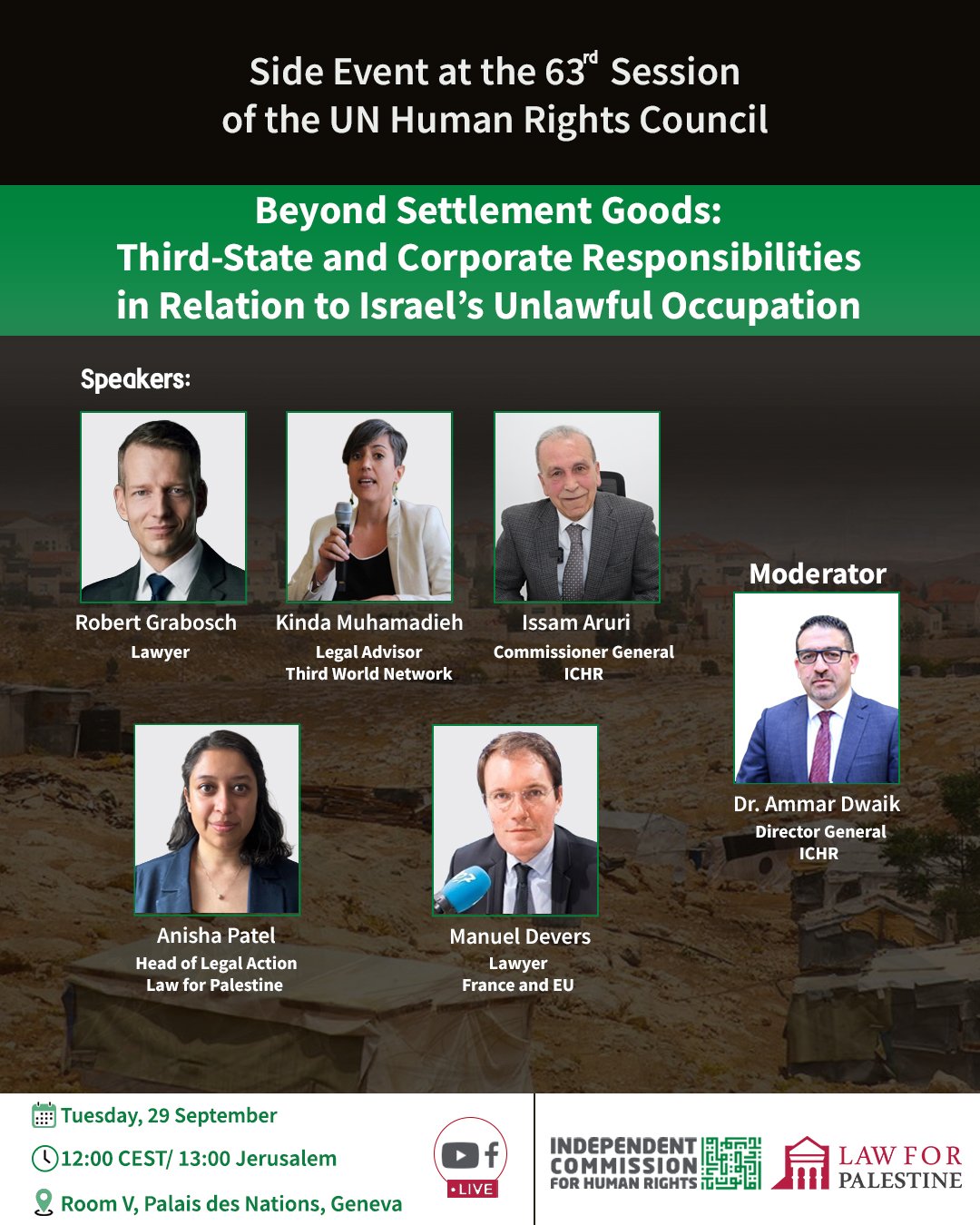
Side Event at the 63rd Session of the UN Human Rights Council
Beyond Settlement Goods: Third-State and Corporate Responsibilities in Relation to Israel’s Unlawful Occupation
Date and Time: Tuesday, 29 September, 12:00 – 13:00
Location: Room V, Palais des Nations, Geneva
Organised by: The Independent Commission for Human Rights and Law for Palestine.
Format: In-person event with live online broadcast.
Background:
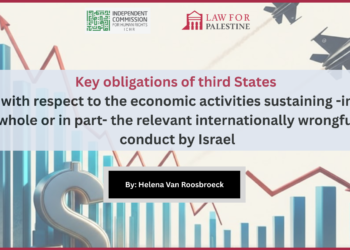
For decades, Israel’s unlawful occupation and settlement enterprise have been sustained not only through military force and government policy, but also through an extensive economic architecture in which States, financial institutions and corporations participate, facilitate, finance and profit.
In its July 2024 Advisory Opinion, the International Court of Justice (ICJ) concluded that Israel’s continued presence in the Occupied Palestinian Territory is unlawful and clarified the obligations of third States in responding to that situation. The Court stated that States must take measures to prevent trade or investment relations that assist in maintaining the unlawful situation created by Israel in the Occupied Palestinian Territory.
Yet the economic machinery sustaining this unlawful situation remains deeply embedded in international markets. Settlement goods continue to enter foreign markets, while companies provide construction equipment, transport, tourism, infrastructure, technology and other services linked to the unlawful occupation. Banks provide loans, underwriting and financial services to companies involved in the settlement economy. Institutional investors and pension funds may hold shares or bonds in companies materially involved in activities sustaining the occupation, often without meaningful knowledge or consent on the part of workers and beneficiaries. Public authorities continue to award contracts and provide market access to entities connected to unlawful activities. Other private actors may likewise become participants in, or contributors to, systems that generate and sustain serious violations. The 2025 report of UN Special Rapporteur Francesca Albanese, From economy of occupation to economy of genocide, further illustrates the scale and significance of this economic dimension.
The distinction between Israel’s economy and the settlement economy is, moreover, difficult to sustain in practice. Settlements are not isolated commercial enclaves: they are integrated into Israel’s infrastructure, financial system, corporate structures, supply chains and markets, while benefiting from State subsidies, preferential policies, land allocation, infrastructure and other forms of governmental support.
Meaningful implementation of the third-State obligations identified by the ICJ, as well as related duties of cooperation, therefore requires examination of the wider economic ecosystem sustaining the unlawful occupation. This includes trade in goods and services, construction and infrastructure, tourism, banking and investment, pension funds, insurance, public procurement, technology and corporate supply chains.
There are already indications of what such measures could look like in practice. On 2 May 2024, Turkey announced the suspension of all import and export trade with Israel. At the July 2025 Bogotá Conference of the Hague Group, States adopted coordinated diplomatic and economic measures, including commitments to review public contracts to prevent public institutions and funds from supporting Israel’s unlawful occupation. At EU level, action has remained very limited in the absence of consensus among Member States. This has increasingly led individual Member States to consider or adopt national measures to meet their international obligations. Legal scholars have also argued that an EU prohibition on trade with unlawful settlements can be adopted under Article 207 TFEU through the Common Commercial Policy, rather than being treated as a CFSP measure requiring unanimity.
Speakers
- Issam Aruri, Commissioner General – ICHR.
- Kinda Muhamadieh, Legal Advisor – Third World Network
- Anisha Patel, Head of Legal Action – Law for Palestine
- Robert Grabosch – Lawyer
- Manuel Devers, Lawyer – France and EU
Moderator:
- Ammar Dwaik, Director General – ICHR
The event will be live-streamed on YouTube