Experts Examine State and Corporate Responsibilities for Economic Activity Linked to Israel’s Unlawful Occupation at UN Human Rights Council
Geneva, Switzerland – 29 September 2026
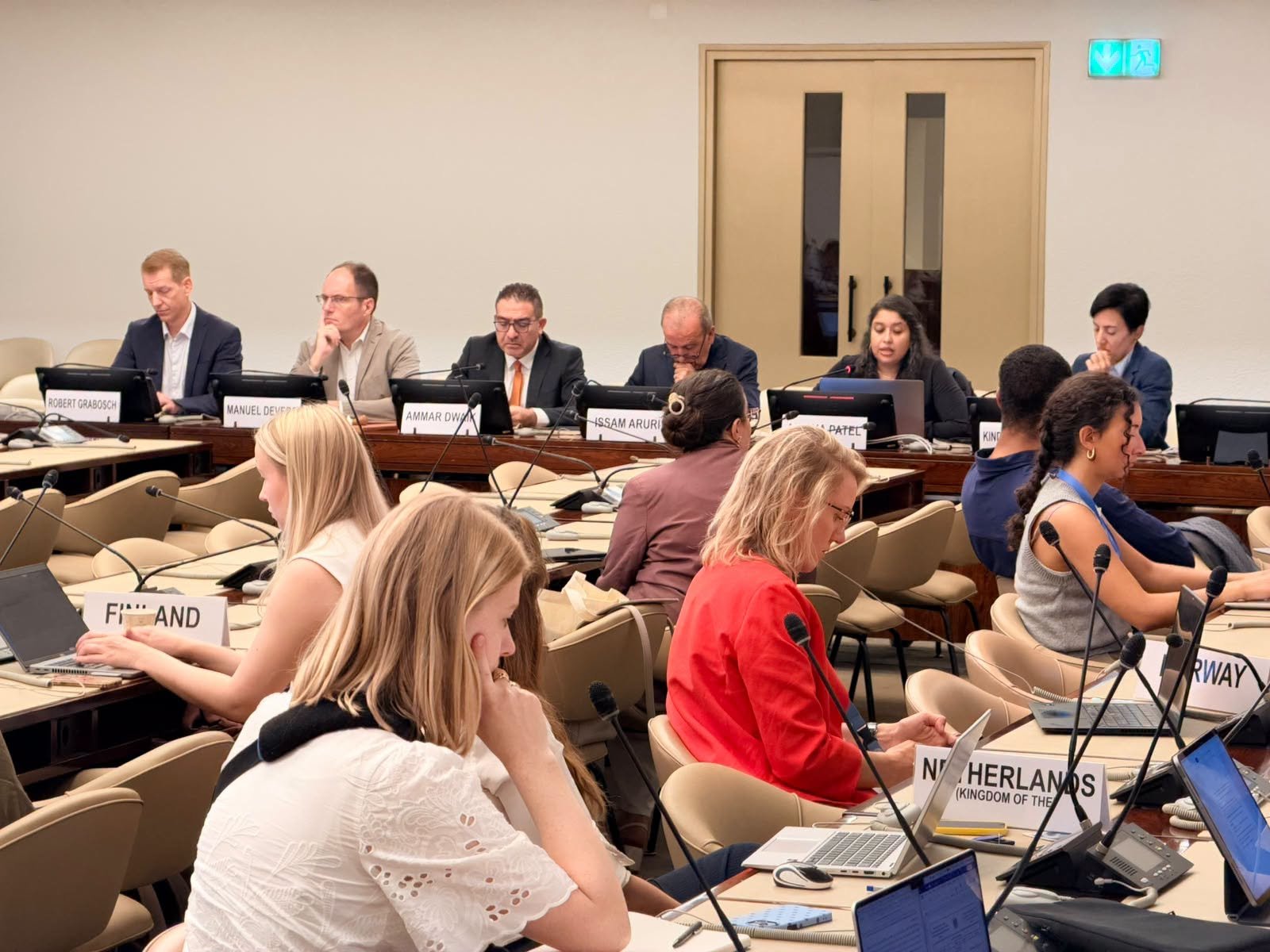
Law for Palestine (L4P) and The Independent Commission for Human Rights (ICHR) convened a high-level side event at the Palais des Nations in Geneva, on the sidelines of the 63rd session of the United Nations Human Rights Council. Entitled “Beyond Settlement Goods: Third-State and Corporate Responsibilities in Relation to Israel’s Unlawful Occupation”, the event brought together legal and human rights experts, diplomats, researchers, representatives of states, and civil society organisations.
Discussions reflected on the legal responsibilities of third States and companies in the context of Israel’s continued unlawful occupation of the Occupied Palestinian Territory. Participants examined a broad range of economic structures that contribute to sustaining the occupation and settlement enterprise, including trade and investment, construction and infrastructure, tourism, banking and financial services, public procurement, technology and corporate supply chains along with pathways for third States to bring this to an end, in line with their legal obligations.
The discussion drew, in particular, on the July 2024 Advisory Opinion of the International Court of Justice (ICJ) on the legal consequences arising from Israel’s policies and practices in the Occupied Palestinian Territory. This included the Court’s conclusion that Israel’s continued presence in the Occupied Palestinian Territory is unlawful, as well as the obligations this entails for third States. The speakers also reflected on the obligations arising for third States under the Convention on the Prevention and Punishment of the Crime of Genocide.
Restrictions on Movement and Access: Part of a Wider Reality
The event was moderated by Dr Ammar Dwaik, Director General of the ICHR, who spoke about the daily impact of restrictions on movement and access. Dwaik summarised the deteriorating situation on the ground by explaining the everyday reality in Area A. He said that although his son’s university is only a ten-minute drive from their home in Ramallah, access to it has been disrupted after Israeli settlers took over the internal road, raising Israeli flags and preventing Palestinian vehicles, with plans for surveillance measures, checkpoints, watchtowers and cameras to be installed along the route.
Dwaik placed these developments in the broader context of Israeli control over Area C of the West Bank, highlighting the associated restrictions on planning and construction, movement and access to land and resources, as well as checkpoints and surveillance measures that restrict Palestinians’ ability to reach their homes, workplaces and places of education.
The Economic Impact on Palestinians
In his intervention, Issam Aruri, Commissioner General of the ICHR, shared testimony about the direct impact of Israeli policies and practices on Palestinians’ lives and livelihoods, highlighting the case of a Palestinian farmer from Beit Rima, north of Ramallah. Aruri said: “Today, I carry with me the voice of an elderly Palestinian farmer from Beit Rima, north of Ramallah. Just a few days ago, his family’s ancient olive grove, which they had owned for centuries, was uprooted. These were trees planted, tended and harvested by successive generations. They were destroyed, leaving the family without one of its main sources of livelihood.”
Aruri stressed that this was not an isolated case, but reflected what the ICHR has documented as a wider pattern of economic harm resulting from the destruction of agricultural livelihoods across the West Bank.
He said that more than 21,500 trees were damaged or uprooted in August 2026 alone, including more than 19,000 olive trees, as Palestinians prepared for the olive harvest. The harvest is an important source of income and food security, as well as being deeply significant culturally and socially.For Palestinian farmers, he explained, an olive tree is more than an agricultural resource. It is also part of a family’s history and its connection to the land. Its destruction therefore has consequences that extend far beyond the immediate financial loss.
Aruri also highlighted the continuing increase in restrictions on movement and access across the West Bank, including East Jerusalem. He noted that the number of movement obstacles had risen from 925 in December 2025 to 945, the highest figure recorded in two decades.
Third-State Responsibilities: Non-Recognition and Non-Assistance
Anisha Patel, Head of Legal Action at Law for Palestine, said that the serious violations of international law documented by Palestinian human rights organisations over many years are increasingly reflected in the findings and opinions of international courts and UN mechanisms.
She explained that the responsibilities of third States in relation to these violations include, among other things, the duty not to recognise as lawful the situation arising from Israel’s presence in the Occupied Palestinian Territory, not to render aid or assistance in maintaining that situation, and to cooperate to bring violations to an end.
Patel also referred to obligations arising under the Convention on the Prevention and Punishment of the Crime of Genocide, including the duty to prevent genocide, not to be complicit in it, and to ensure accountability, in light of findings and determinations by the relevant international bodies.
She stressed that the occupation and settlement enterprise cannot be considered separately from the wider economic structures of the State of Israel and its economy. States, she emphasized, must therefore scrutinise their trade and investment relationships, arms transfers, financial services, academic cooperation and other forms of engagement that may contribute to maintaining an unlawful situation.
International Economic Law: State Obligations Extend Beyond Settlement Goods
Kinda Muhamadieh, Legal Advisor at the Third World Network, broadened the discussion to consider the relationship between third-State responsibilities and international economic law. Muhamadieh explained that the duty not to render aid or assistance cannot be reduced to restricting settlement goods alone, given the extensive links between the Israeli economy and economic activities in the Occupied Palestinian Territory.
She said States must consider the full range of their economic, diplomatic, military, financial and academic relationships with Israel and assess whether those relationships contribute to maintaining the unlawful situation.
Muhamadieh reminded States that international trade and investment rules should not automatically be viewed as an obstacle to States fulfilling their obligations under international law. She pointed to legal avenues within the World Trade Organization framework, bilateral agreements and international investment law that States can use when adopting measures to meet their international obligations.
She emphasised the importance of applying these obligations consistently and without selectivity, warning that allowing political or economic considerations to determine when such measures are applied risks undermining the credibility and effectiveness of international law.
European Union: The Potential of Trade Policy
Manuel Devers, a lawyer specialising in French and European Union law, addressed the European legal framework governing trade connected to settlements, drawing on the case law of the Court of Justice of the European Union.
He explained that the Occupied Palestinian Territory has a separate and distinct legal status from Israel, and that economic transactions relating to the territory must take into account, among other considerations, the Palestinian people’s right to self-determination and the requirement for their consent to transactions concerning their occupied territory.
Devers noted that restrictions on settlement-related trade could, as a matter of EU law, be adopted under the Common Commercial Policy. This could avoid the requirement for unanimity among EU Member States, rather than treating such measures as punitive measures under the EU’s Common Foreign and Security Policy, where unanimity is required and is currently unavailable.
Corporate Responsibility and Value Chains
Robert Grabosch, a German lawyer specialising in business and human rights, focused on corporate responsibility and national enforcement mechanisms. He stressed that the UN Guiding Principles on Business and Human Rights establish a responsibility for companies to respect human rights across their operations and throughout their supply and value chains and business relationships. States, he said, have a responsibility to take appropriate measures to prevent companies from becoming involved in human rights violations.
Grabosch called on States to fulfil these responsibilities by taking effective measures to prevent corporate involvement in violations. He also called for clearer international guidance and stronger national frameworks to ensure effective protection of Palestinian rights, including through legislation, administrative measures and judicial mechanisms that allow companies to be held accountable where their activities contribute to human rights violations.
* The event was broadcast live online. A recording of the livestream is available here.