New Academic Paper Warns ICRC’s Updated Interpretation of Human Shields Could Weaken Civilian Protection in Gaza
A new study by Neve Gordon and Nicola Perugini argues that the International Committee of the Red Cross’s 2025 Commentary on the Fourth Geneva Convention risks expanding the legal justifications for civilian killings and destruction during armed conflicts.
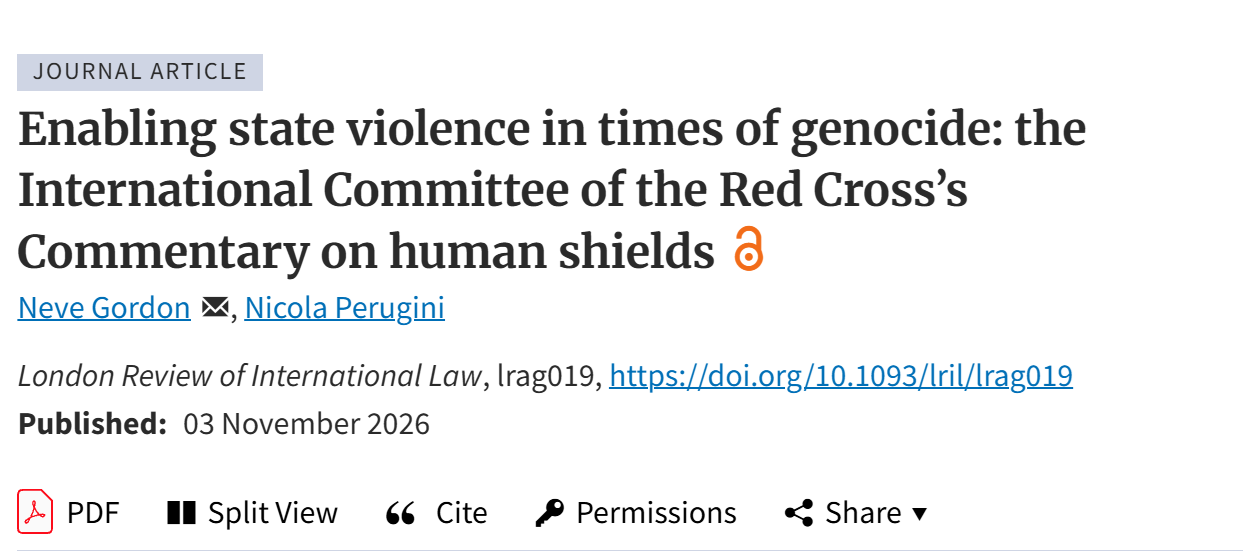
A newly published academic paper by scholars Neve Gordon and Nicola Perugini raises serious concerns about the implications of the International Committee of the Red Cross’s (ICRC) updated interpretation of the prohibition on using human shields in armed conflicts. Published in the London Review of International Law, the paper, titled “Enabling State Violence in Times of Genocide: The International Committee of the Red Cross’s Commentary on Human Shields,” examines how the ICRC’s 2025 Commentary on the Fourth Geneva Convention could undermine, rather than strengthen, protections for civilians.
At the centre of the authors’ analysis is Article 28 of the Fourth Geneva Convention of 1949, which prohibits the use of protected persons as human shields. While the ICRC presents its updated Commentary as an effort to reinforce civilian protection in contemporary warfare, Gordon and Perugini argue that its revised interpretation significantly broadens the circumstances in which civilians and civilian objects may be considered legitimate targets.
The authors are particularly concerned about the timing and potential consequences of this interpretation amid Israel’s genocidal campaign in the Gaza Strip. They highlight how Israel has repeatedly invoked accusations of human shielding to justify attacks on Palestinian civilians and the destruction of civilian infrastructure. According to the paper, the expanded interpretation risks providing further legal grounds for such justifications, allowing entire urban areas and civilian populations to be framed as part of an alleged human shielding strategy.
One of the paper’s central criticisms concerns the Commentary’s broad understanding of the concept of human shielding, particularly its treatment of the presence and intentions of armed groups. Gordon and Perugini argue that ambiguous language and an expanded understanding of what constitutes human shielding could enable states to portray vast civilian spaces as connected to military activity. This, they warn, could weaken the distinction between civilians and combatants, a fundamental principle of international humanitarian law.
The paper also questions what the authors identify as the ICRC’s state-centric approach to interpreting international humanitarian law. They argue that the organisation relies heavily on state military manuals and practices, despite the fact that states themselves may have an interest in expanding the legal justifications for using force while delegitimising non-state armed actors. This approach, they contend, risks reviving restrictive interpretations of the laws of war that undermine protections for populations living under occupation and in asymmetric conflicts.
The implications extend beyond Gaza. The authors warn that the Commentary could influence international legal proceedings, including debates surrounding alleged violations of the Genocide Convention. Although international humanitarian law and the Genocide Convention are distinct legal frameworks, interpretations of the laws governing armed conflict can play an important role in assessing whether conduct during warfare constitutes genocide. An expanded interpretation of human shielding could therefore be invoked by states seeking to defend military operations against allegations of war crimes, crimes against humanity and genocide.
In their conclusions, Gordon and Perugini describe the ICRC’s updated Commentary as a missed opportunity to strengthen civilian protection. They urge the organisation to reconsider its interpretation of human shielding, move away from its state-centred approach and establish stricter legal thresholds for determining when civilians may lose their protected status. They also stress the need for the ICRC to confront how states instrumentalise international humanitarian law to legitimise military violence.
For the authors, Gaza must serve as a turning point for international humanitarian law, prompting renewed efforts to uphold the principles of civilian protection established in the aftermath of the Second World War, rather than allowing them to be further eroded.
* To read the full study, click